
Review · BAMBERG TOURS
Witch Trials in Bamberg
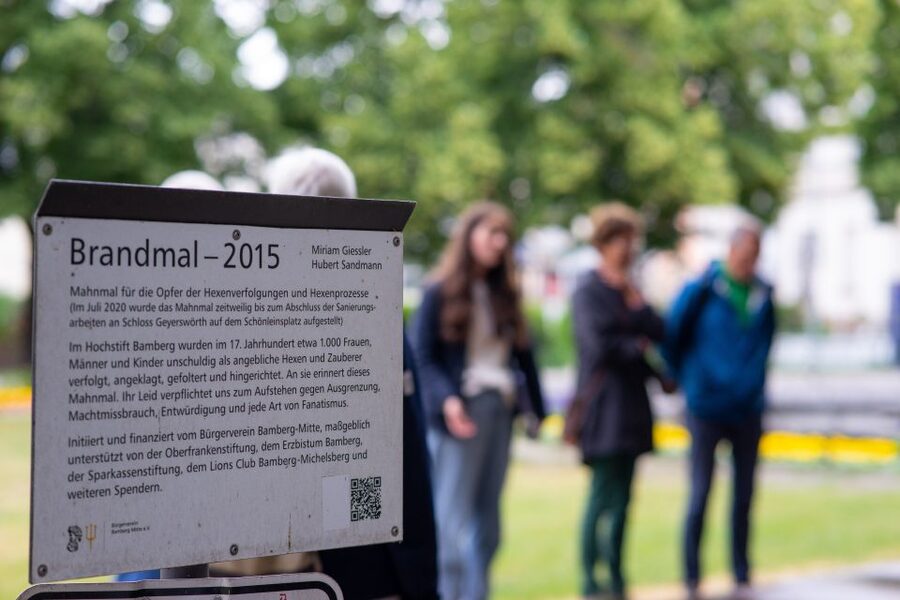
Bamberg’s witch trials were not a fairy-tale story about red-haired women and old mothers. They were a city-wide campaign that caught men and women from every social class, including mayors, and sent many people into prison, torture, and death. This 1.5-hour walk brings that grim past into the lanes and squares of the old town.
I like the way the tour connects witch-hunt history with everyday medieval Bamberg, rather than treating the subject as a spooky sideshow. I also like the short walking route, which takes you from the cathedral area to sites linked with the old prisons and the Malefiz-Haus. The main drawback is that the tour is in German, so you will need a strong understanding of the language to follow the guide’s explanations.
Key points to know before booking
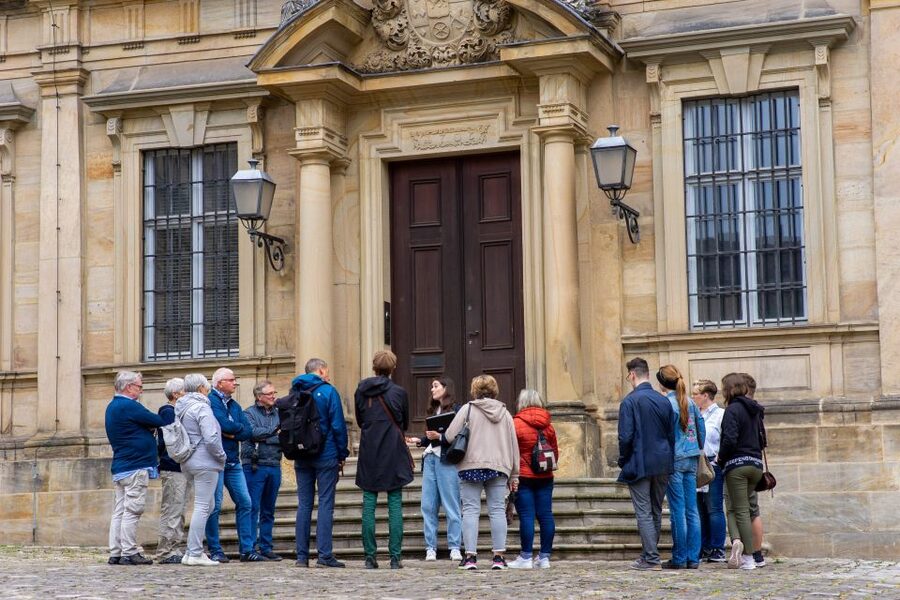
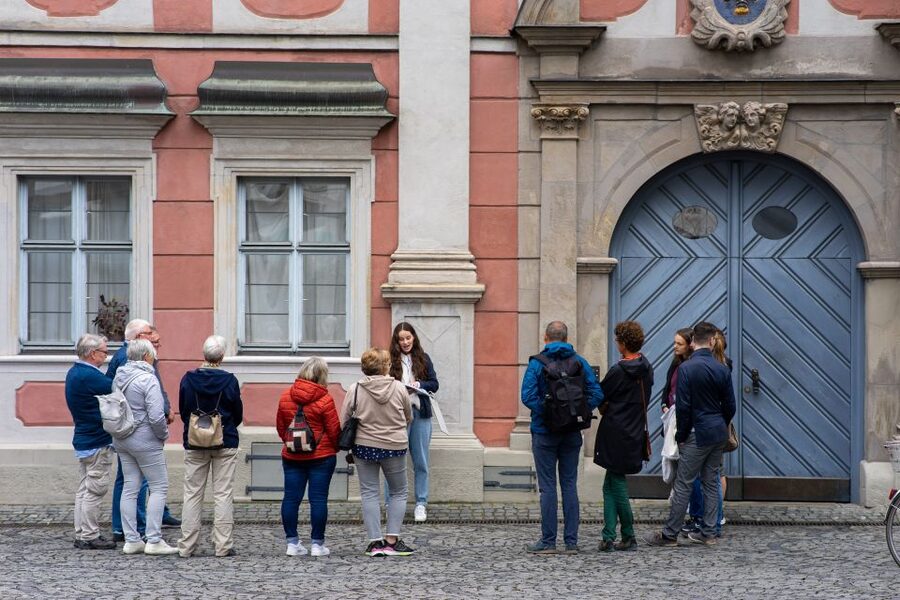
- The route begins at Bamberg Cathedral Square: Meet in front of the entrance to the Alte Hofhaltung, where your guide carries a picture folder and wears a Geschichte Für Alle e.V. name tag.
- The Trudenhaus was a real prison: Anyone sent to Bamberg’s witch prison was in serious danger, and the tour explains how this system worked.
- The walk covers several old-town locations: Stops include the Old Court, Geyerswörth Palace, medieval prison sites, and the former Malefiz-Haus.
- The focus goes beyond superstition: You learn how fear, authority, social pressure, and the legal system shaped the persecution.
- The tour lasts 90 minutes: The route includes several short walks of two to six minutes between guided stops.
- It costs $15 per person: That is a reasonable price for a live historical walk, especially if you want context that sightseeing alone will not provide.
Why Bamberg’s witch trials make a powerful walking tour

Bamberg is easy to admire at street level. Its old town has handsome buildings, narrow lanes, and grand civic and religious landmarks. Yet the witch trials reveal a much harsher side of the city, one that is easy to miss if you only photograph the pretty facades.
The persecution reached its height in the 17th century. Hundreds of people became victims, and the accusations were not limited to one type of person. The popular picture of a witch as an elderly woman living on the edge of society is far too narrow here. Men were accused. Women from different backgrounds were accused. People with standing in the community could also be pulled into the system.
That matters because it changes how you read Bamberg. The town is not simply a backdrop for dark stories. Its courts, government, religious institutions, prisons, and public spaces all formed part of the setting in which accusations took hold.
I appreciate that the tour looks at how Bamberg has dealt with this past up to the present day. You are not given a parade of shocking punishments with no context. Instead, the guide places the events within the city’s wider story and asks how ordinary people and officials could accept such a system.
A few more Bamberg half-days to weigh up
- Bamberg: Guided Walking Tour
★ 4.6 · 3,202 reviews - Bamberg: Guided Beer History Tour with Optional Tasting
★ 4.6 · 772 reviews - Bamberg: City Highlights Walking Tour
★ 4.6 · 679 reviews
Meeting at the Alte Hofhaltung on Domplatz
The tour begins on Domplatz, the cathedral square, in front of the entrance to the Alte Hofhaltung, or Old Court. Look for a guide holding a picture folder and wearing a name tag marked Geschichte Für Alle e.V.
This is a practical meeting point. Domplatz is one of Bamberg’s clearest landmarks, and the Old Court gives you a useful first sense of the city’s layered past. You are starting beside a major historic complex, not at an anonymous street corner.
The opening stop sets the tone for the walk. The subject is dark, but the tour also introduces the city itself. As you move through the old alleys, you get a better sense of how the different parts of Bamberg fit together and how political, religious, and civic power occupied the same compact town.
Give yourself enough time to find the guide before the start. The tour information does not name individual guides, but the guide is identifiable through the picture folder and organization name tag.
The Old Court and the city behind the story
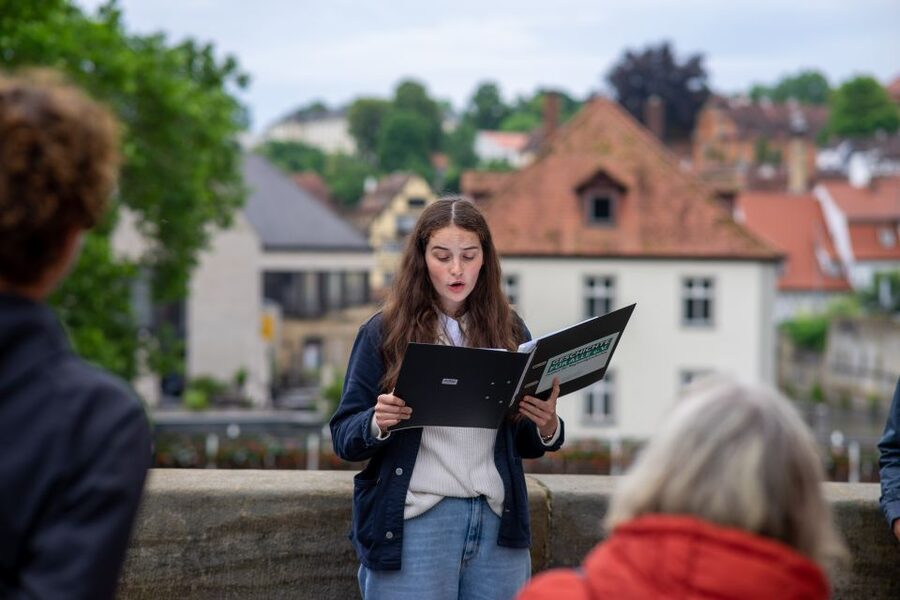
The Old Court is one of the first major stops. Here, the guide begins the story of Bamberg’s witch persecutions while placing it against the city’s broader development.
This is valuable because witch trials did not happen in isolation. They required institutions, accusations, questioning, records, and people with the power to act. A stop at an important civic site helps you think about the machinery behind the events instead of reducing them to old superstition.
You will also learn that Bamberg’s story connects to the wider history of witch hunts in Nuremberg. The experience is therefore not only a local tale. It places Bamberg within the larger pattern of persecution in the region.
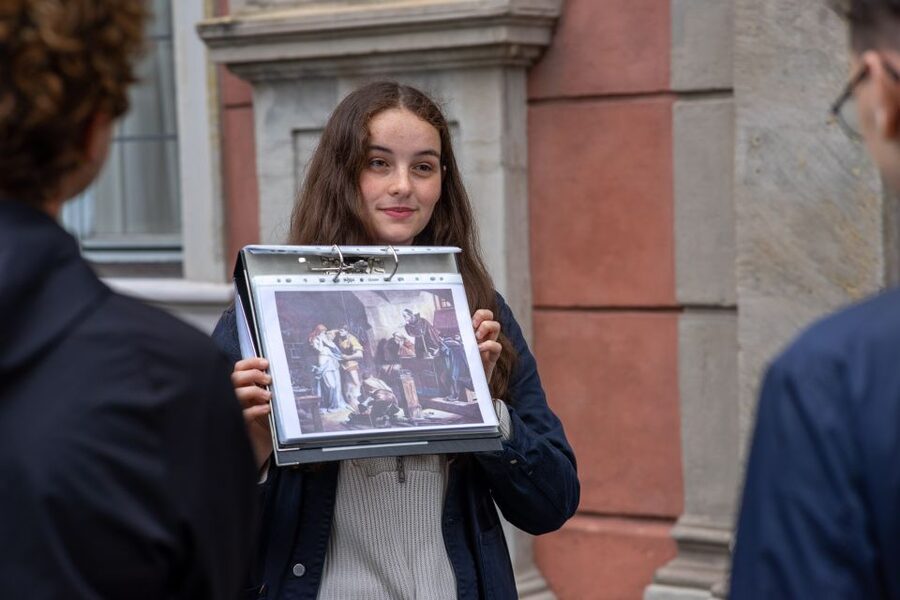
Expect the guide to use a picture folder during the explanations. That can help make past buildings, people, and events easier to understand, especially when a particular site has changed over time or no longer looks as it once did.
The strength of this section is context. If you simply walk Bamberg on your own, you can see the Old Court but not the fear and authority that shaped the city during the witch hunts. The limitation is that the stop is historical rather than an interior attraction. You are learning through spoken explanation and the surrounding streets.
Geyerswörth Palace and the short route through old Bamberg
From the Old Court, the group walks about five minutes to the next guided stop. Later sections of the route include walks of roughly four, two, five, and six minutes, so this is a genuine walking tour but not a strenuous one.
Geyerswörth Palace is another important stop on the route. Its value is not only architectural. The guide uses the location to continue the account of Bamberg’s political and social world during the period of persecution.
I like this kind of route because the old town becomes part of the evidence. You are not seated in a museum room hearing a detached lecture. You are moving through the spaces where the city’s institutions and residents lived, worked, governed, and suffered.
The short distances also keep the tour moving. You are unlikely to spend long stretches simply marching from place to place. Each walk is followed by another guided explanation, so the route has a clear rhythm: listen, move, look, and listen again.
Still, you should expect the experience to be mostly outdoors. Cold weather can affect your comfort. One February tour remained interesting despite the cold, but that does not make warm clothing optional. Wear shoes suited to old-town streets and dress for the season.
Same city, a completely different sort of afternoon:
- Bamberg: Guided Historical Culinary Tour
★ 4.6 · 461 reviews - Bamberg: Immersive Medieval Tour
★ 4.7 · 232 reviews - Bamberg: Private Guided Walking Tour
★ 4.8 · 90 reviews - Bamberg: Beer & Brewery Tour – 2 Hour – English & German
★ 5.0 · 87 reviews
The Trudenhaus, Bamberg’s witch prison
The Trudenhaus is one of the most important ideas in the tour. It was Bamberg’s witch prison, and the phrase alone tells you how organized the persecution had become.
The tour explains that a person sent to the Trudenhaus was effectively lost. This was not a brief holding place where an accused person could expect a fair chance to return home. It was part of a process that could lead to confession under pressure, further accusations, and death.
The word Trudenhaus can sound like something from folklore, but the reality was painfully concrete. The story is about buildings, legal power, imprisonment, and the treatment of real people. That contrast is one of the strongest reasons to take the walk.
The itinerary also refers to medieval prison spaces known as Lochgefängnisse. These prison cells help you understand the physical side of the system. Witch trials were not just ideas written in documents. They involved confinement in harsh conditions, with the accused removed from normal life and placed under the control of authorities.
You should not expect a preserved prison attraction with a long interior visit. The tour is a guided walk through the city, and the emphasis is on explanation at historic locations. The reward is the connection between place and story. The tradeoff is that the exact prison spaces may not offer a large exhibition or a fully staged reconstruction.
The medieval prison cells and the human cost
The Lochgefängnisse provide a chance to consider the experience of imprisonment from the accused person’s point of view. The setting makes the story more immediate, but the guide’s interpretation matters just as much as the physical site.
A good explanation here should help you understand how vulnerable a person became after an accusation. The tour’s subject is not simply who was called a witch. It is also how a person could be isolated, pressured, and treated as guilty before the process had truly ended.
The experience is especially useful for visitors who want to understand the thinking of the period. The information stresses the beliefs and attitudes that shaped the hunts, rather than presenting medieval people as foolish caricatures. That approach gives you a clearer view of how fear could become official policy.
I would pay close attention to the guide’s explanation of social class. The fact that accusations reached people from different levels of society, including Bamberg mayors, is one of the most important points. It shows that the hunts were not only aimed at powerless outsiders.
The tour can be emotionally heavy. It is suitable for adults and older children who can handle a serious historical subject, but it is not a light ghost walk. Go for social and political history, not theatrical scares.
The Malefiz-Haus and the final stop
The walk ends at the location of the Malefiz-Haus from 1627 to about 1650. This final stop gives the experience a clear endpoint and returns the story to a specific place in Bamberg.
The name Malefiz-Haus is closely tied to the legal punishment of the period. By ending here, the tour leaves you with the central fact that the witch hunts operated through a system of accusation and punishment, not simply through rumor passed from neighbor to neighbor.
A final location like this also helps you keep the chronology in mind. You have moved through civic and palace settings, considered prison spaces, and then arrived at a site linked with the punishment system. The sequence gives the walk a sense of structure.
Do not expect the final stop to resolve every question. Ninety minutes is enough for a focused introduction, not an entire academic study of witch trials in Bavaria. What you get is a strong foundation for seeing Bamberg differently and for understanding why this chapter still matters.
What the German-language format means for you
The live guide speaks German. This is the single biggest booking consideration.
If you understand German well, the tour offers a direct way to hear the story in the language of the city. The guide can answer questions, explain details, and adjust the discussion as the group moves along. Recent feedback describes the explanations as informative, engaging, and detailed enough to answer questions at length.
If you do not speak German, this is not a good choice simply because the subject interests you. The route itself will not communicate enough without the spoken commentary. Check carefully before booking, since the listed language is German only.
The guide’s use of a picture folder is helpful, but it does not replace the live explanations. You should treat the visuals as support rather than as a substitute for translation.
Price, duration, and overall value at $15
At $15 per person, this is a modestly priced way to spend 90 minutes in Bamberg. You are paying for a trained live guide and a carefully organized route through several meaningful sites, not for admission to a large museum or a full-day excursion.
I think the value is strongest if you are already planning to explore the old town. The walk adds a historical layer to places you might otherwise pass without understanding. It also saves you the work of piecing together the witch trials from scattered books, plaques, or online sources.
The price is less compelling if you want a highly visual attraction, an English-language tour, or access to a fully preserved prison interior. Those are not the main offerings here. The experience depends on the guide’s storytelling and your interest in listening.
The overall rating is 4.4 out of 5 from 187 bookings, which fits the experience described by the available feedback. The most praised qualities are clear explanations, informative content, and an engaging presentation. One particularly useful point is that the tour can remain worthwhile in cold weather because the subject and storytelling keep the group focused, though you should still dress properly.
Cancellation is flexible: you can cancel up to 24 hours before the start for a full refund. You can also reserve now and pay later, which helps if your Bamberg schedule is still changing. For groups of 10 or more, contact Geschichte Für Alle e.V. by email. A booking confirmation serves as proof of payment, and an invoice cannot be issued for bookings made through GetYourGuide.
Who should take this Bamberg walk?
I would choose this tour if you enjoy local history, difficult subjects, and guided walks that connect buildings to real events. It suits visitors who want more than a quick look at Bamberg’s beautiful center.
It is also a good fit for people interested in the history of witch hunts across Germany. The connection with Nuremberg gives the Bamberg story a wider frame, while the local stops keep the material tied to actual streets and institutions.
You may want to skip it if you prefer cheerful sightseeing, dislike serious historical themes, or need an English-language tour. The experience is not designed as entertainment in the usual sense. Its power comes from examining how fear and authority affected ordinary citizens.
The route is listed as wheelchair accessible, which is useful for visitors who need an accessible walking experience. Still, the tour involves moving through old-town streets and several stops, so it is sensible to confirm any personal mobility needs when booking.
Should you book Witch Trials in Bamberg?
Book it if you want a focused, affordable history walk in German and you are curious about the people and institutions behind Bamberg’s witch persecutions. The short route, clear meeting point, and $15 price make it an easy addition to a day in the old town.
I would be especially keen to take it after seeing Bamberg’s main sights, when the city’s palaces and alleys are familiar but their darker associations are not. Just remember that this is a spoken German tour, outdoors for much of its 1.5 hours, and centered on a grim chapter of history. If those conditions suit you, it offers a thoughtful look at Bamberg that ordinary sightseeing cannot provide.
FAQ
Where does the Witch Trials in Bamberg tour begin?
Meet the guide on Bamberg’s Domplatz, in front of the entrance to the Alte Hofhaltung, also called the Old Court.
How do I identify the tour guide?
The guide will carry a picture folder and wear a name tag showing Geschichte Für Alle e.V.
How long does the tour last?
The walking tour lasts 1.5 hours.
What language is the tour in?
The live tour guide speaks German, and German is the listed tour language.
Is the tour wheelchair accessible?
Yes. The activity is listed as wheelchair accessible.
What does the tour cost?
The price is $15 per person.
Can I cancel the booking?
Yes. You can cancel up to 24 hours before the tour for a full refund. You can also reserve now and pay later.
Just added around Bamberg
- Private Guided Walking Tour of Bayreuth With A Professional Guide★ 5.0 · 3 reviews
- Bamberg Countryside Breweries Beer Hike Food Experience★ 5.0 · 27 reviews
- Bamberg – Excursion to Seehof Palace★ 5.0 · 3 reviews
- Culinary-historical walk through Bamberg★ 4.0 · 7 reviews
- Bamberg Private Walking Tour With A Professional Guide★ 4.5 · 27 reviews
- Bayreuth Scavenger Hunt and Sights Self-Guided Tour★ 5.0 · 7 reviews
- Outdoor Escape Game with puzzle backpack Bamberg: The Secret of the Horseman★ 4.7 · 39 reviews
- Bamberg: Immersive Medieval Tour★ 4.7 · 232 reviews
Bamberg Tours, compared.
Browse the lists this tour appears in