
Review · LEIPZIG TOURS
Music in Leipzig – Bach, Wagner and the Thomanerchor
Leipzig’s musical story comes alive on foot, from Bach’s work at St. Thomas Church to Wagner’s birthplace and the city’s long choral tradition. I like the way this tour connects famous names to real streets, churches, and concert institutions rather than treating music history as a list of dates. I also like the musical examples and 18th-century street sounds, which give the walk some atmosphere.
The tour’s private format is another plus. You can book one group of up to 25 people, and guide Tom has been praised for his engaging, clear explanations and genuine enthusiasm. The main drawback is that the walk lasts only 90 minutes, and a scheduled church stop can be affected by opening hours. One booking found the churches closed and expected more music during the tour.
Key points to know before booking
- Bach takes center stage: Follow his Leipzig story through St. Thomas Church and St. Nicholas Church, including the 1723 performance connected with Bach’s arrival as cantor.
- The Music Trail links major institutions: Learn how St. Thomas Church, the opera, Gewandhaus, conservatory, and music museums fit into Leipzig’s cultural life.
- Audio adds atmosphere: Musical pieces by Bach and recreated 18th-century street sounds make this more than a standard city walk.
- The group is private: Your booking covers up to 25 people, which can be good value for a family, school, or larger party.
- Tom is a noted guide: If Tom leads your walk, expect an animated presentation with room for questions.
- Allow for church access limits: St. Nicholas Church may not be open at the planned time, so the interior portion is not guaranteed.
Why Leipzig is a serious music city
Leipzig is often introduced as a trade fair and commerce center. That is true, but it tells only half the story. The city also carries the names of Bach, Wagner, Mendelssohn, and Schumann, along with the continuing work of its choirs, orchestras, opera company, and conservatory.
This tour is useful because it shows you how those names connect. You are not simply told that a composer lived in Leipzig. You follow a route through the old center and learn how churches, concert halls, schools, and civic life supported music.
I like this approach for a first visit. You get a compact introduction to the city’s musical identity without needing to know the difference between a cantor, a conductor, and a conservatory professor before you arrive. The guide supplies the framework, while the streets and buildings give the facts a physical setting.
The 90-minute length also suits a busy day. You can fit it between other Leipzig plans, though you should not expect a full museum visit or a complete history of every composer connected with the city.
A few more Leipzig half-days to weigh up
- Leipzig: City History Canal Sightseeing Tour on a Motorboat
★ 4.7 · 6,232 reviews - Leipzig: 1.5-Hour Public Tour with Night Watchman Bremme
★ 4.6 · 3,116 reviews - Combo Tour in Leipzig: Guided City Tour & City Sightseeing
★ 4.7 · 2,317 reviews
Meeting at Leipzig’s Old Town Hall
The walk begins at the Museum Shop in the Altes Rathaus, or Old Town Hall, at Markt 1. This is a practical meeting point in the center, and it places you close to Leipzig’s main historic streets from the first minute.
Starting here makes sense. The old town is the setting for much of the city’s public life, and the route can move naturally from civic Leipzig toward its churches and musical institutions. You do not need to arrange transport for the tour itself. It is a walking experience, and the meeting point is given clearly.
Because the group is private, the guide can speak to your party rather than to a mixed crowd. The maximum is 25 people, so the value depends on your group size. For 20 to 25 people, $188 works out to a modest per-person price. For two people, it becomes a much more expensive private walk, though you gain a more personal format and the chance to ask questions freely.
The listed guide languages are Spanish, English, French, German, Italian, and Russian. Confirm the available language when choosing a time, since the language list does not mean every guide offers every language at every departure.
Following Bach from church to city
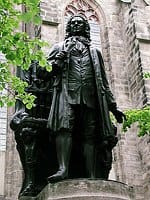
Johann Sebastian Bach is the heart of the tour. Bach worked in Leipzig as cantor of the St. Thomas Church Choir, a role that tied him to religious services, teaching, and the city’s wider musical life.
You hear about the Thomanerchor, the famous St. Thomas Church Choir, and its 800-year history. That long span matters. The choir is not presented as a short-lived group linked only to Bach, but as an institution that has helped define Leipzig for centuries.
The walk also uses excerpts from pieces Bach composed in Leipzig. This is one of the most valuable parts of the experience. A date or title can slip from your mind, but hearing music while standing in the city where it was written gives the story a stronger edge.
The tour includes the sound of an 18th-century city as well. This is a small but clever touch. It helps you picture the conditions in which Bach worked: streets filled with ordinary movement, church bells, trade, and public noise rather than the quiet of a modern concert hall.
You should keep your expectations in check. The information promises musical examples, not a concert. One booking felt there was less music than expected. If you want a full performance, book a separate concert or choir service as well. If you want a guided introduction with short audio moments, the format makes more sense.
St. Thomas Church and the Thomanerchor
St. Thomas Church is one of the central stops because Bach’s Leipzig career is closely tied to it. The church is also linked with the St. Thomas Choir, whose long history reaches back 800 years.
The value here is not just the building. Your guide explains how the choir fits into Leipzig’s musical life and why it remains known far beyond the city. You get a better sense of the connection between religious institutions and professional music in Leipzig.
The route is especially good for people who know Bach’s music but have never studied his biography. You can place his Leipzig work in a real neighborhood, then connect it to the choir and other musical centers introduced later in the walk.
The available information does not promise a choir rehearsal, service, or concert. Do not book this tour expecting to hear the Thomanerchor perform. The emphasis is on the church, the choir’s history, and the guide’s explanation.
Same city, a completely different sort of afternoon:
- Leipzig: 1.5-Hour Historical Walking Tour in German
★ 4.7 · 2,217 reviews - Leipzig: 2-Hour Guided Walking Tour in German
★ 4.8 · 1,612 reviews - Leipzig: 13-Stop Hop-on/Hop-off Bus Ticket
★ 4.6 · 1,468 reviews - Gruseltour Leipzig: A Haunted Guided Tour
★ 4.5 · 1,385 reviews
St. Nicholas Church and the 1723 Bach connection

St. Nicholas Church provides another important stop. You are shown the bust of Bach and learn about his first performance there in 1723, shortly after his Leipzig appointment as cantor.
This detail gives the tour a useful sense of arrival. Bach was not an abstract figure who simply belonged to Leipzig forever. He came to the city, began a new post, and presented his work in its churches.
The church is also a reminder that historic sites do not always operate on a tour’s schedule. One booking found the churches closed at the planned time. That means you may receive the exterior explanation and surrounding context even if you cannot go inside.
I would treat the interior as a welcome possibility, not a guarantee. If entering St. Nicholas Church is the most important part of your day, check opening conditions before booking and keep your schedule flexible.
Wagner, Mendelssohn, and Schumann along the route
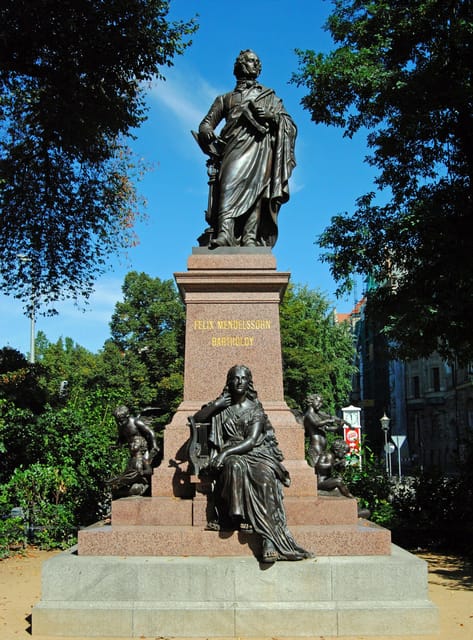
Bach is the strongest thread, but the tour places him in a wider circle of Leipzig musicians. Richard Wagner was born in Leipzig, and the city was also home to major figures such as Felix Mendelssohn and Robert Schumann.
That broader focus prevents the walk from becoming a single-composer pilgrimage. You see Leipzig as a working music city, where different generations used its churches, concert institutions, teaching centers, and public spaces.
Wagner’s connection is especially notable because his birthplace is in Leipzig’s birth registry. The city is not only where he later built a reputation. It is part of his earliest story.
The tour also introduces the Gewandhaus and the opera. These institutions show that Leipzig’s musical identity extends beyond sacred music and Bach. You learn about the city’s orchestral, theatrical, and educational life in the same walk.
The route cannot give every composer equal time in 90 minutes. I would expect a selective overview rather than long biographies. That is a good trade for a short orientation, but dedicated Wagner, Mendelssohn, or Schumann fans may want a separate museum visit afterward.
Gewandhaus, opera, and the institutions behind the music
The great names are easier to understand when you know where music was taught and performed. The walk discusses the Gewandhaus, opera, conservatory, and music museums as part of Leipzig’s continuing cultural network.
This is where the tour moves beyond a basic old-town walk. You are shown how a city can build a musical reputation through several institutions working at once. Performers need venues, students need teachers, choirs need traditions, and audiences need places to gather.
The conservatory is part of that story. The tour explains the role of professors and music education in shaping Leipzig’s musical life. That context is useful if you are interested in how cultural centers survive beyond the fame of one historic person.
You may not enter every institution named on the route. The description focuses on learning about these places and their role in music history. Think of the walk as a guided introduction to Leipzig’s cultural map, not an admission tour of several museums and halls.
What the guide adds to the experience
A good music walk needs more than a list of composers. The guide has to explain connections, answer questions, and keep the story moving while the group walks.
Tom has been singled out for his competence, humor, and enthusiasm. His strength appears to be making the links between people and institutions feel natural rather than forced. That matters on a topic with plenty of names and dates.
Another booking praised the tour for offering many facts without burying the group in numbers. That is the right balance for a 90-minute walk. You get enough detail to understand Leipzig, but not a lecture packed with dates that you will forget before lunch.
You should still tell the guide what interests you most. If your group is focused on Bach, ask for more detail on his Leipzig work. If Wagner or the opera matters more, say so early. A private group gives you more room for that kind of adjustment than a large public tour.
Price, group size, and practical value
The price is $188 per group of up to 25 people. That is not a per-person ticket, so the value changes sharply with group size.
For a larger family group, music club, school group, or gathering of friends, the cost can be quite reasonable. Splitting the price among 10 people comes to about $19 each, and a full group brings the per-person cost down further.
For one or two people, the price is harder to justify unless private guiding is important to you. A public city walk may cost less, but it may not focus so closely on music or allow the same freedom to ask questions.
The 90-minute duration limits the amount of content, but it also keeps the commitment manageable. You get a focused introduction instead of spending half a day on one theme. The tour is wheelchair accessible, which helps make the format workable for more members of a mixed group.
You can cancel up to 24 hours before the start for a full refund, and you can reserve without paying immediately. Those terms are useful if your Leipzig plans are still changing.
Who should book this Leipzig music walk?
I would recommend it most strongly to:
- First-time Leipzig visitors who want a clear cultural introduction
- Bach listeners who want to connect his music with real places
- Families and private groups looking for a shared activity
- Visitors who prefer a guided walk to a museum-only experience
- Music students, choir members, and concert fans
- People who want a short tour that fits around other plans
It is less suitable if you want a full concert, a long indoor museum visit, or guaranteed access to every church on the route. It may also feel brief if you already know Leipzig’s music history well.
The multilingual format is useful for international groups, and the private setup can make the experience more comfortable for families or friends with different levels of music knowledge. You do not need to be a Bach expert. The route is designed to explain the city’s musical connections as you go.
Should you book Music in Leipzig?
Book this tour if you want to understand why Leipzig matters to music history and you value a live guide who can connect buildings, composers, choirs, and institutions. The best parts are the Bach excerpts, the recreated 18th-century soundscape, and the explanation of the Thomanerchor’s long role in the city.
The private group price is strongest when shared among several people. Before committing, remember that church access can change and the musical examples are brief rather than a concert. If those limits suit you, this is a smart 90-minute introduction to Leipzig’s musical character, especially with a guide such as Tom leading the walk.
FAQ
Where does the tour meet?
The meeting point is the Museum Shop at the Altes Rathaus, or Old Town Hall, at Markt 1 in Leipzig.
How long does the experience last?
The walking tour lasts 90 minutes.
How much does the tour cost?
The price is $188 per group of up to 25 people.
Is this a private tour?
Yes. The activity is offered as a private group tour.
Which languages are available?
The listed guide languages are Spanish, English, French, German, Italian, and Russian.
Is the tour wheelchair accessible?
Yes, the activity is described as wheelchair accessible.
Does the tour include musical examples?
Yes. The experience includes pieces composed by Bach in Leipzig and sounds representing an 18th-century city.
Can I cancel for a full refund?
Yes. You can cancel up to 24 hours in advance for a full refund.
Just added around Leipzig
- Federal Administrative Court Leipzig: A journey into the heart of German justice★ 4.8 · 189 reviews
- Leipzig: City Highlights Express Guided Tour★ 4.8 · 5 reviews
- Der Leipziger Passagen-Rundgang in der Altstadt★ 4.8 · 124 reviews
- 1.5-Hour Historical Tour of Leipzig with Costumed Guide★ 4.5 · 128 reviews
- Leipzig: Floodplain Forest & City River Cruise★ 4.9 · 334 reviews
- Leipzig: Riverside Forest Tour on the Pleiße★ 4.6 · 347 reviews
- Leipzig: 360° Panorama THE CATHEDRALE OF MONET ticket★ 4.7 · 410 reviews
- Leipzig: 2-hour Auwald Motorboat Tour★ 4.5 · 439 reviews
Leipzig Tours, compared.

City History Canal Sightseeing Tour on a Motorboat
Read our review →
1.5-Hour Public Tour with Night Watchman Bremme
Read our review →
Combo Tour in Leipzig: Guided City Tour & City Sightseeing
Read our review →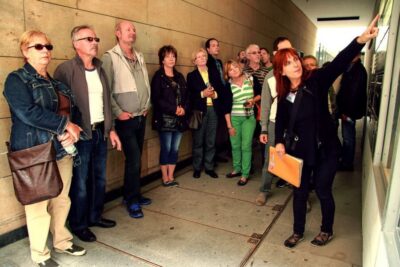




Browse the lists this tour appears in