
Review · HANOVER TOURS
Hanover Private Walking Tour With A Professional Guide
Hanover’s story comes into focus on foot, from the red-brick Market Church to the silent ruins of Aegidien Church and the grand dome of the New Town Hall. In about two hours, you see how medieval power, royal ambition, wartime destruction, and modern remembrance all meet in the city center.
I like the private format, which lets your guide adjust the pace and explain the parts of Hanover that matter most to you. I also like the chance to meet guides such as Anna, who can tailor the discussion to your interests and accommodate a late arrival when possible. The main catch is that the New Town Hall dome lift costs extra, and two hours is a tight schedule if you want long visits inside the buildings.
Key Points To Know Before Booking
- Seven central sights in two hours: The route links the Market Church, Old Town Hall, Ballhof, Kreuz Church, Oskar-Winter-Fountain, Leibniz House, Aegidien Church, and New Town Hall.
- A private English-language walk: Your own party gets the guide’s attention, with the tour described as serving up to 15 people. Another part of the information gives a 25-person maximum, so confirm the limit when booking.
- A tour built around Hanover’s contrasts: Medieval churches, a philosopher’s former home, war ruins, and a royal-era city hall all appear on one compact route.
- No transport is needed: The walk takes place around the central sights and begins near public transportation at Hanns-Lilje-Platz.
- The dome lift is an optional cost: Admission is not included, but the curved lift to the top of the New Town Hall reaches 98 meters.
- Flexible cancellation: You can cancel at least 24 hours before the start for a full refund.
Why This Short Hanover Walk Works
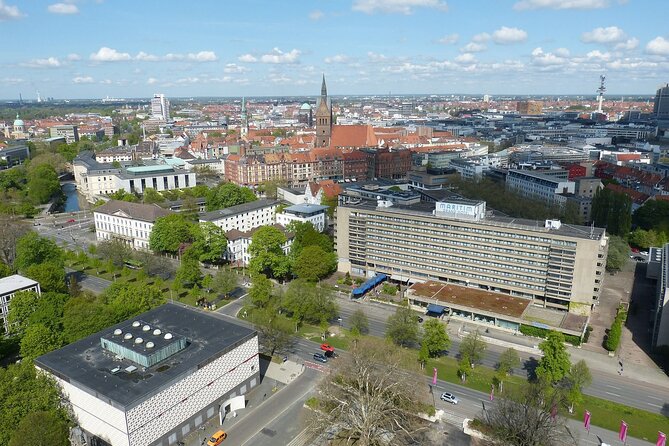
Hanover is not a city that reveals everything from a passing train window. Its center has been rebuilt, altered, and reshaped over centuries, so a guide helps connect pieces that might otherwise feel scattered. The Market Church may look like a grand Gothic church, while Aegidien Church is little more than a roofless shell. Together, they tell a much larger story.
I like this tour because it keeps the scope sensible. Two hours is enough to get your bearings and see the central landmarks without turning the day into a march from one end of town to the other. You still have the rest of the day for museums, shopping, food, or a slower return to whichever sight catches your interest.
The private setup matters most if your group has a particular focus. You can ask for more on architecture, Hanover’s wartime destruction, the city’s royal connections, or the people linked to the buildings. Anna is specifically praised for shaping the material around personal interests, so she appears to be a good fit for visitors who prefer conversation over a fixed speech.
The tradeoff is pace. Seven landmarks in around two hours means you should expect an exterior-focused walking tour, with explanations at each stop rather than long indoor visits. If you want to study every church or spend time inside the New Town Hall, plan to return later.
More walking tours in Hanover:
- Hannover: Guided Old Town Walking Tour
★ 4.5 · 338 reviews - Hanover: Crime Walking Tour
★ 4.5 · 243 reviews - Hanover: Flashlight Guided Walking Tour at Night
★ 4.7 · 52 reviews
Meeting Market Church, Hanover’s Red-Brick Landmark
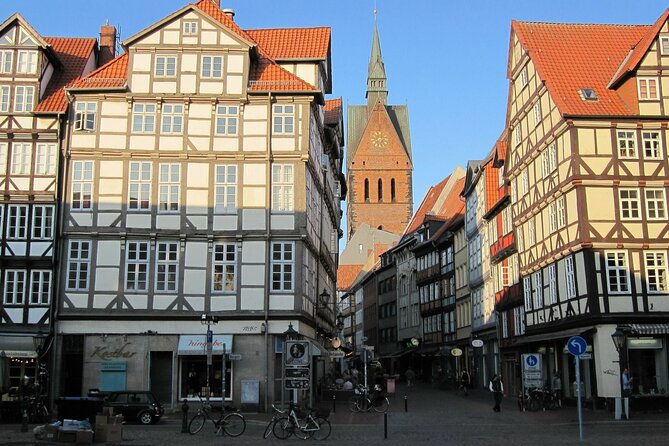
The walk begins at Hanns-Lilje-Platz 2, in front of the Market Church. This is a practical starting point because the church is easy to recognize and sits in the middle of Hanover’s old center. The tour information also gives the Market Church as the meeting landmark, so arrive with enough time to find the square and your guide.
The church dates from the 14th century and is one of the best-known examples of North German brick Gothic design. That red-brick construction is one of the first visual clues that Hanover belongs to northern Germany rather than the stone-built regions farther south.
Your guide explains how the church was partly destroyed during an air raid in 1943 and later restored. Its tall western tower was more than a religious feature. It represented the power and wealth of the town’s citizens, and it remains one of Hanover’s key visual markers.
I find this an effective opening because it gives you both architecture and context right away. You are not simply looking at an old church. You are looking at a building that survived severe damage and still anchors the city center.
Old Town Hall, Coats of Arms, and the Ballhof
Near the Market Church, you see the Old Town Hall. Construction took about 100 years, and the building combines Romanesque influences with Neo-Gothic architecture. That long building period helps explain why the structure does not feel like a single, clean architectural statement.
Your guide points out the portraits of princes and coats of arms on the murals. These details are easy to miss when you walk past on your own, especially if you are focused on the larger rooflines and brickwork. Ask your guide to explain which figures and symbols matter most if heraldry and political history interest you.
The nearby Ballhof Building adds a different note. It began as a sports hall for ball games, offering shelter from wind and rain. It later served as an assembly hall and then as a theater.
This is one of the route’s useful small surprises. Hanover’s historic buildings were not built for just one purpose and left untouched. The Ballhof shows how a civic space can change with the needs of the city. It also breaks up the church-and-government sequence with a place tied to recreation and public life.
Winding Alleys and the Oldest Church in Hanover
From the Ballhof, the route moves through winding alleys toward Kreuz Church. Dating from 1333, Kreuz Church is described as the oldest church in Hanover.
Like much of the old center, the church suffered major destruction during the Second World War and was rebuilt afterward. That fact matters when you look at Hanover’s historic core. Some buildings are medieval in origin but postwar in their present form. The city’s past is visible not only in old walls, but also in the choices made when those walls had to be reconstructed.
The walk through the narrow streets is one of the places where a private guide adds practical value. A guide can point out corners you might otherwise pass without noticing and keep the route moving without forcing you to stop at every doorway. Anna is praised for showing lesser-seen corners of Hanover, which fits this part of the walk particularly well.
You should not expect a lengthy church visit here. The tour is designed as a compact overview, so treat Kreuz Church as a historical stop within the larger route. If it catches your eye, note its location and return later.
A few more Hanover half-days to weigh up
- Hannover: 24-Hour Hop-On Hop-Off Sightseeing Bus Ticket
★ 4.2 · 298 reviews - Hanover: SEA LIFE Entry Ticket
★ 4.1 · 160 reviews - SEA LIFE Hannover Ticket
★ 4.0 · 96 reviews - Hanover: Royal Gardens of Herrenhausen Guided Tour
★ 4.6 · 78 reviews
Turn the Ring at Oskar-Winter-Fountain
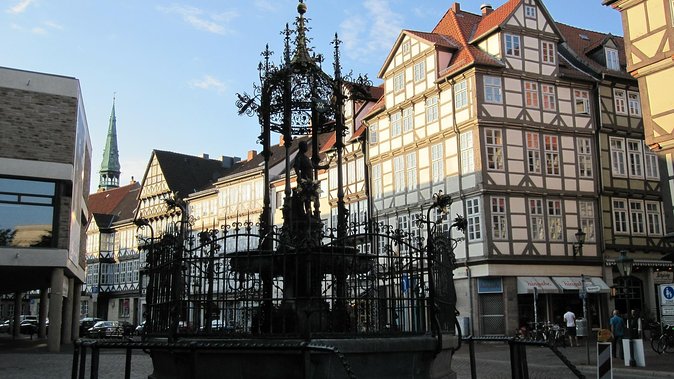
The Oskar-Winter-Fountain is a smaller sight, but it gives the walk a bit of local character. A legend says that your wish will come true if you turn the small brass ring set into the ironwork.
This kind of detail is easy to skip on a self-guided route. It takes only a moment, but it gives you something active to do rather than another building to photograph. You can make your wish, listen to the story, and continue toward the next stop.
Behind the fountain is Leibniz House, associated with mathematician and philosopher Gottfried Wilhelm Leibniz, who lived there. Leibniz was born in 1646 and died in 1716, placing the house within the period when Hanover was growing in political and intellectual importance.
The tour information identifies this as the place where Leibniz lived, so your guide can help put the building and its famous resident into context. If you are interested in science, mathematics, or philosophy, this is a good moment to ask for more detail. If those subjects are not your priority, the stop is brief enough not to slow the entire walk.
Aegidien Church and the Peace Bell
Aegidien Church is the route’s most powerful stop. It was destroyed during the Second World War and was never repaired or reconstructed. Instead, the remaining ruins serve as a reminder of war.
That decision gives the site a different feeling from the restored Market Church and Kreuz Church. Reconstruction can return a building to public use, but ruins can preserve the visible fact of destruction. At Aegidien Church, the damage is not hidden behind a new roof or fresh masonry.
Inside the ruins, you find the Peace Bell, donated by Hiroshima. Each year on August 6 at 8:15 a delegation from Hiroshima rings the bell in memory of those killed in the air raid.
This stop deserves a little quiet attention. The rest of the route includes architecture, legends, and civic history. Aegidien Church asks you to consider the human cost of war and the link between two cities marked by air attacks. It is also a useful reminder that Hanover’s old center is not simply a preserved medieval quarter. Much of what you see carries the marks of the 20th century.
Because the tour lasts only two hours, the guide may keep the visit moving. Still, you can ask for a moment to look around the ruins before continuing.
New Town Hall and the 98-Meter Dome Lift
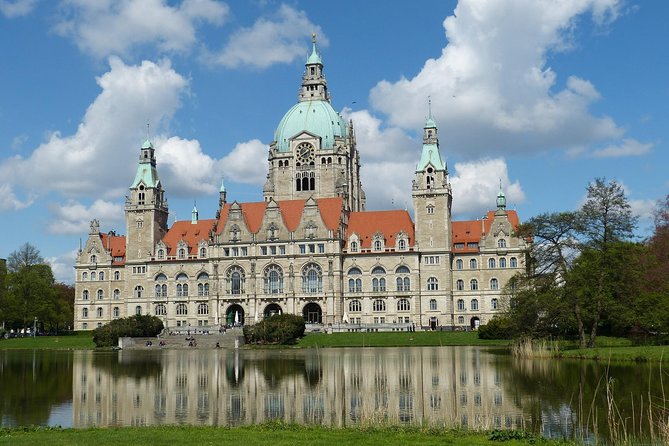
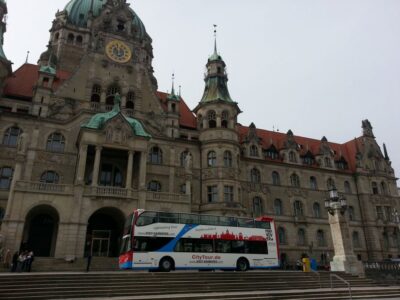
The final major stop is Hanover’s New Town Hall. Its scale makes the earlier old-town buildings feel modest. The building opened in the presence of Emperor Wilhelm II, and its construction cost was famously high for the period.
The design reflects Hanover’s civic ambition. This was not meant to be a small administrative office. It was a grand statement about the city, its resources, and its place in the German Empire.
Inside the green dome is a curved lift that climbs 98 meters. The lift is described as the only one of its kind in Europe, and it leads to a viewpoint over Hanover. On a clear day, you might also see the Harz Mountains.
Admission to the New Town Hall lift is not included in the tour price. That is the clearest extra cost to remember. If the view matters to you, ask your guide how the timing works on the day and budget separately for admission.
The lift also affects the two-hour schedule. A ride to the top, time at the viewpoint, and any waiting could take a meaningful part of the tour. You may prefer to treat the city hall as the tour’s final explanation, then decide whether to pay for the lift and continue independently.
What The Private Format Is Worth
The listed price is $305.84 per group, not per person. For a full group of 15, that works out to roughly $20 per person, which is fair for a private two-hour guide. For two people, the cost is much higher per head, so the value depends on how much you want personal attention.
The private format lets you ask questions without worrying about holding up a large public group. It also gives the guide room to adjust the material. Anna is described as friendly, attentive, and able to focus on specific interests. She also accommodated a late arrival while still providing the full tour, though you should not assume every delay can be handled the same way.
The supplied information gives two different maximum group sizes: the main details say up to 15 people, while one highlight says a maximum of 25. Confirm the exact limit before paying if your party is larger than 15. Either way, the key point is that only your own group participates.
The price does not include admission tickets, and the route does not require transportation. That keeps the basic cost clear, but you should set aside extra money if you want to ride the New Town Hall lift.
Timing, Walking, and Who Will Enjoy It
The tour lasts about two hours and is suitable for any age. No transport is needed, and the meeting point is near public transportation. Most people can take part, according to the supplied participation information.
The route is best for someone who wants a compact introduction to central Hanover. It suits a first visit, a short city break, or a free morning before another activity. It also works well for families and mixed-age groups because the route includes visual sights, stories, a wish-making fountain, and the unusual dome lift.
You should choose a different format if you want long museum visits, a food tour, or extensive time inside each church. This is a walking overview, not a full-day historical study.
Wear comfortable shoes and keep your schedule flexible enough to pause for questions. The tour is short, but the old-town route includes several stops, and the private setting works best when you take advantage of the guide’s ability to respond to your interests.
Booking Ahead and Cancellation
The experience is often booked around 80 days in advance, which suggests that you should not wait until the last moment if your dates are fixed. Confirmation is provided at booking, and the tour is offered in English with a mobile ticket.
You can cancel for a full refund up to 24 hours before the local start time. Cancellations or changes made less than 24 hours before the experience are not refunded or accepted.
My Take: Is This Hanover Tour Worth Booking?
I would book this tour if you want a private, efficient introduction to Hanover and value a guide who can shape the conversation around your interests. The strongest parts are the contrast between restored and ruined churches, the local stories at the Oskar-Winter-Fountain, and the chance to see seven central landmarks without using a car or public transport.
The tour is especially appealing for groups of several people, since the $305.84 price covers the group rather than each person. For a couple, the cost is harder to justify unless personalized attention is important to you.
Confirm the group-size limit, remember that New Town Hall admission is extra, and treat the two-hour route as an overview. If that matches your plans, this is a focused and flexible way to get oriented in Hanover before spending the rest of the day on your own.
FAQ
Where does the Hanover walking tour begin?
The tour begins at Hanns-Lilje-Platz 2, 30159 Hannover, Germany, in front of the Market Church.
Where does the tour end?
The listed end point is 30 Hanover, Germany.
How long does the walking tour last?
The tour lasts approximately two hours.
Is the tour private?
Yes. Only your group participates, with a local guide assigned to your party.
How many people can join the group?
The main tour details state up to 15 people per group. Another description gives a maximum of 25, so confirm the exact limit when booking.
Is transportation provided?
No transportation is needed for this walking tour. The meeting point is near public transportation.
Is admission to the New Town Hall included?
No. Admission tickets are not included. The curved lift to the top of the 98-meter dome has an additional admission cost.
What language is the tour offered in?
The tour is offered in English and includes a mobile ticket.
Just added around Hanover
- Taste and Travel Odyssey in Hanover★ 5.0 · 5 reviews
- Fritz Haarmann murder tour through Hanover’s old town★ 4.5 · 7 reviews
- Goslar City guided tour★ 4.5 · 11 reviews
- Guided tour of the New Town Hall in Hanover★ 5.0 · 4 reviews
- City walk through Hanover★ 4.0 · 20 reviews
- SEA LIFE Hannover Ticket★ 4.0 · 96 reviews
- Hanover: Royal Gardens of Herrenhausen Guided Tour★ 4.6 · 78 reviews
- Hanover: Old Town Historical Walking Tour by Geo Epoche★ 4.4 · 11 reviews
Hanover Tours, compared.






Browse the lists this tour appears in