
Review · DORTMUND TOURS
Dortmund: 24-Hour Hop-On Hop-Off Sightseeing Bus Ticket
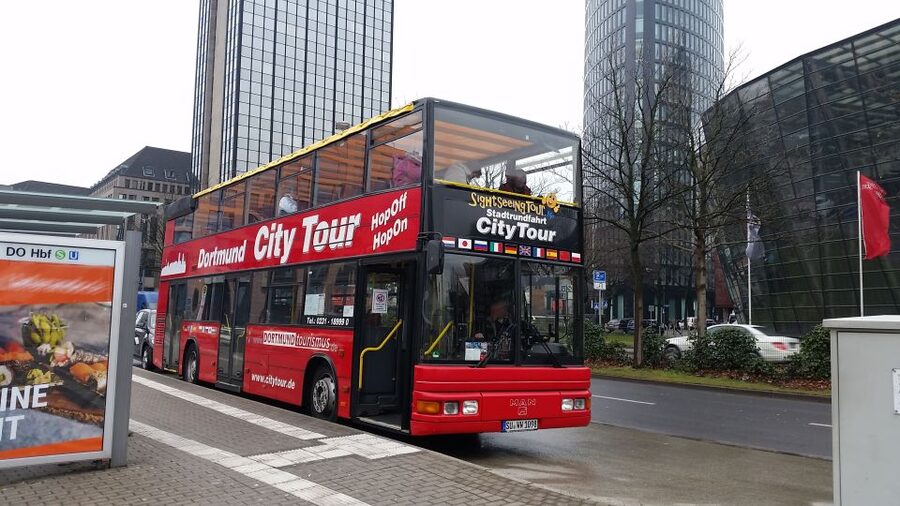
Dortmund’s best story is its change from a coal-mining and steel-working city into a place shaped by football, parks, universities, museums, and former industrial sites. This open-top bus gives you that story from street level, linking the football stadium, Phoenix Lake, Westfalenpark, Rombergpark, the harbour, and the German Football Museum in one loop. I like the 13-stop route and the chance to see far-flung parts of the city without piecing together local transport. I also like the multilingual audio guide, especially if you want background while watching Dortmund roll past the windows.
The main drawback is the timetable. Buses leave Dortmund Central Station at only 10:20 a.m., 12:20 p.m., 2:20 p.m., and 4:20 p.m., so a missed bus can cost you time. The upper deck is weather-dependent, seats cannot be reserved, and the audio commentary may not be fully up to date.
Key points to know before riding
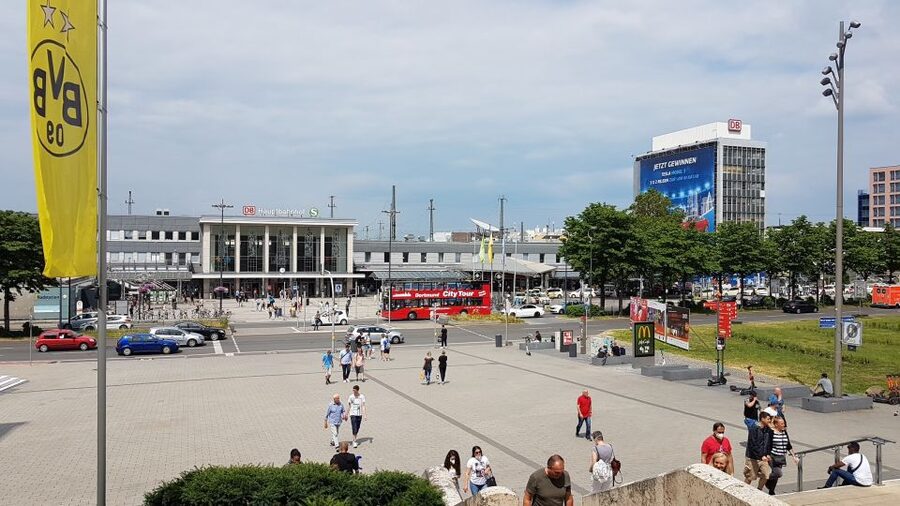
- Four departures from Central Station: The main departures are at 10:20 a.m., 12:20 p.m., 2:20 p.m., and 4:20 p.m., with full loops arriving back at noon, 2 p.m., 4 p.m., and 6 p.m.
- Thirteen stops across Dortmund: The route connects the central city with the harbour, university, stadium, parks, Phoenix Hall, Phoenix Lake, and key central sights.
- A useful city-change story: Commentary explains Dortmund’s shift from coal and steel toward culture, sport, and six universities.
- Open-top views with a lower accessible area: The lower level is barrier-free and suitable for wheelchair users, while dogs are allowed downstairs.
- Audio in many languages: Commentary is available in Chinese, German, Dutch, English, French, Japanese, Italian, Polish, Russian, and Spanish.
- Plan around the gaps: The service is punctual and friendly, but the long intervals make checking the timetable at each stop important.
Dortmund in one loop, from steelworks to football
This is not just a central-city circuit. The route is useful because Dortmund’s major sights are spread out, and several of the most interesting ones are outside the compact center.
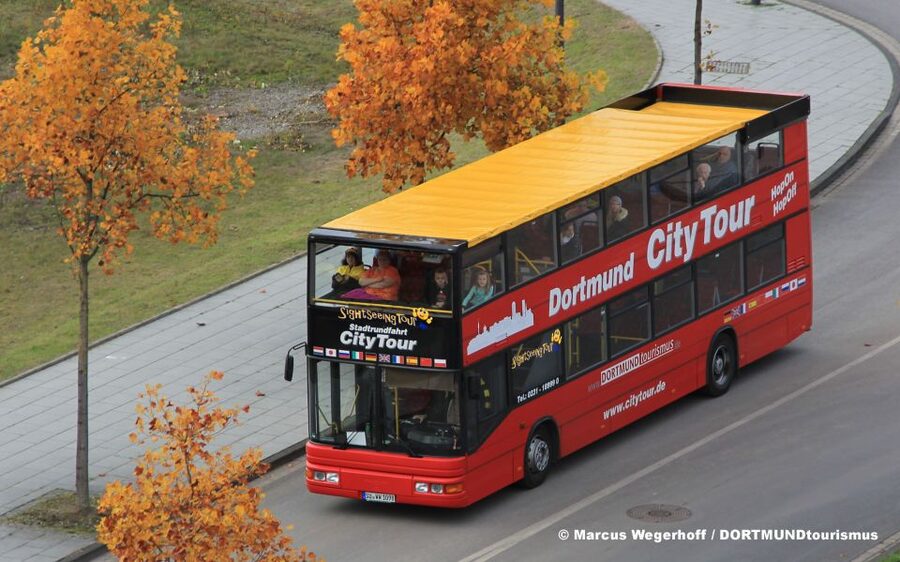
From the top deck, you get a broad view of the city as the bus moves between old industrial ground, green public spaces, sports sites, and newer redevelopment. The audio commentary adds context about Dortmund’s former coal and steel economy and the structural changes that followed. That theme gives the ride more purpose than a simple list of buildings.
The tour lasts one day from first activation, with the published circuit running from late morning into the early evening. If you stay aboard for the full route, the Central Station departures and arrivals suggest a loop of roughly 100 minutes. In practice, you will get more from the ticket if you use the bus as a connector and step off at one or two stops.
At $28 per person, the ticket is not the cheapest way to move around Dortmund. It can still make sense if you want a guided overview, prefer not to navigate several connections, or plan to visit stops on opposite sides of the city. If you only want to go from the station to the center, local transport would likely be better value, but that is not what this ticket is designed for.
More hop-on hop-off passes in Germany:
- Berlin: Hop-on Hop-off Bus Tour with Live Commentary
★ 4.3 · 8,579 reviews - Hamburg: Line A Sightseeing Hop-On Hop-Off Bus Tour
★ 4.6 · 6,958 reviews - Berlin: City Sightseeing Hop-On Hop-Off Bus Tour
★ 4.1 · 4,233 reviews
Central Station and Dortmund’s central sights
Central Station is the easiest starting point. It is the main departure point, with buses leaving at 10:20 a.m., 12:20 p.m., 2:20 p.m., and 4:20 p.m. The route also returns here, with listed arrivals at noon, 2 p.m., 4 p.m., and 6 p.m.
Starting at the station gives you a simple way to ride the complete circuit before deciding where you want to get off. It also reduces the risk of arriving at an unfamiliar stop just after the bus has gone.
The central portion includes Town Hall and Reinoldi Church. These stops are useful if your main interest is Dortmund’s city center, rather than its industrial and sports attractions. The central sights also make good orientation points early in your visit.
I would not use the bus only for these inner-city stops. The most distinctive part of this tour is the way it reaches the harbour, university area, stadium, parks, and Phoenix redevelopment. Still, if you have limited time, staying near the center lets you combine the ride with your own walking plans.
Kreuzviertel and the route toward Dortmund Harbour
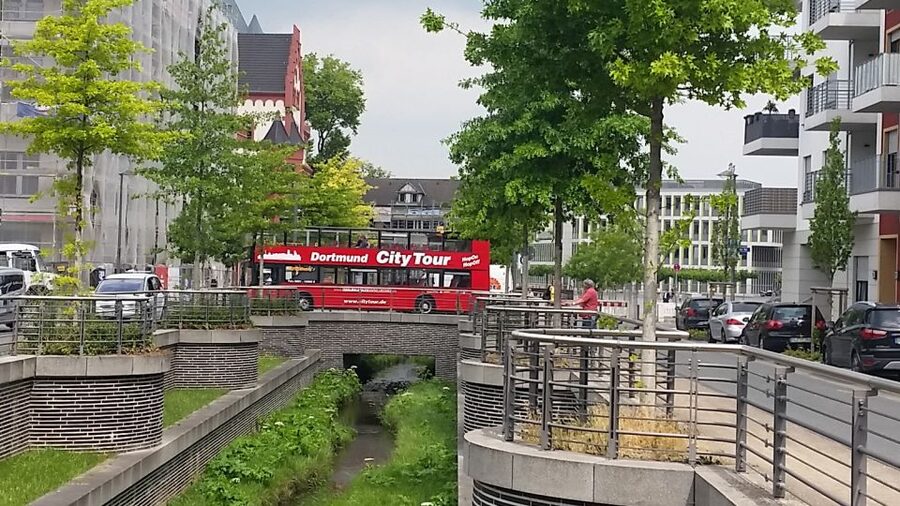
Kreuzviertel is one of the early neighborhood stops. The route gives you a look at a part of Dortmund beyond the main station and central monuments, though the supplied information does not specify a set walking tour or admission included at this stop.
The Harbour stop shifts the story toward Dortmund’s working past and urban change. You can get off here to explore on your own, then wait for a later bus according to the posted schedule. Since there are no seat reservations, I would check the return time before walking away from the stop.
The harbour matters in the context of the whole route. Dortmund’s identity was not built only around its famous football club. Industry, transport, coal, and steel shaped the city, and the tour uses these districts to explain that older Dortmund.
The audio guide is especially useful while passing through areas that may not explain themselves at first glance. You may see streets and redevelopment zones without knowing why they matter. Commentary in your chosen language helps connect those views to the city’s economic past.
DASA and TU Dortmund, two stops with a modern focus
DASA and TU Dortmund show a different side of the city. The route presents Dortmund not only as a former industrial center but also as a place with educational and cultural institutions.
DASA is one of the listed stops, and its place on the route fits the tour’s focus on work, technology, and industry. The activity information does not include admission to DASA, so treat the bus ticket as transportation and city commentary rather than an entrance pass.
TU Dortmund adds the university side of the city’s present identity. Dortmund is home to six universities, and the route uses the university area to show how the city has developed beyond its former industrial base.
These stops are most useful if you want the tour’s broader city story. If you are looking only for postcard sights, you may find them less urgent than Westfalenpark, the stadium, or Phoenix Lake. The advantage is that they help you see Dortmund as a working, studying city rather than only a football destination.
A few more Germany half-days to weigh up
- BVB Signal Iduna Park: Stadium Access and Self-Guided Tour
★ 4.4 · 2,332 reviews - Dortmund: German Football Museum
★ 4.6 · 484 reviews - Dortmund: Borusseum Borussia Dortmund Museum Entry Ticket
★ 4.6 · 315 reviews - Dortmund: Phoenix des Lumières Ticket – Monet
★ 4.2 · 194 reviews
Stadion and the pull of Borussia Dortmund
The Stadion stop is a clear priority for football fans. The bus route takes you to the area around Dortmund’s stadium, allowing you to step off and explore independently.
The supplied details do not promise a stadium tour, match access, or entry to any football attraction. You should therefore view this as a convenient stop and an exterior-area visit unless you arrange something separate.
Even so, the stadium is one of the city’s defining modern sights. It shows the strength of sport in Dortmund’s public identity, and the audio commentary places that football culture within the larger story of a city that has had to reshape itself.
If you want to stop here, check the timetable before leaving the bus. The intervals are long enough that an unplanned pause may turn into a substantial wait. On a busy day, seats are not guaranteed when the next bus arrives, so staying aware of the schedule matters.
Westfalenpark and Rombergpark, Dortmund’s green side
Westfalenpark is one of the most appealing stops for a slower break. The park gives you a chance to leave the bus, stretch your legs, and see a softer side of Dortmund after the industrial districts and stadium area.
Rombergpark offers another green stop later in the route. Having both parks on the circuit is useful because it keeps the tour from becoming a steady run of roads, buildings, and traffic. You can choose one park for a short visit or use the bus to compare the two.
The ticket does not include food or drinks, so plan your break accordingly. The information does not specify cafés, opening times, or admission arrangements at either park, so you should check local details if you want to make a longer visit.
I like these stops because they give the route a better rhythm. A full sightseeing day can feel cramped when every stop is a museum or landmark. A park stop lets you pause, especially if you are traveling with children. One family used the tour as a holiday activity and found the complete route suitable for a day out, though poor weather reduced the appeal of the open upper deck.
Phoenix Hall and Phoenix Lake, industry remade
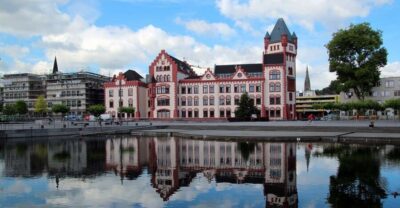
Phoenix Hall and Phoenix Lake are the route’s clearest examples of Dortmund’s industrial change. The former steelworks Phoenix site has been reshaped into a newer urban setting around the lake.
The contrast is the point. You are not simply being shown an old factory district preserved in place. You are seeing how industrial land has been given a different role, with the former steelworks and Phoenix Lake representing a new chapter for the city.
Phoenix Hall is a useful stop if you want to focus on the industrial story. Phoenix Lake offers a more open setting and a chance to get off the bus for your own look around. The route lets you connect both stops without arranging separate transport.
The exact amount of time you can spend here depends on the bus schedule. Since departures are limited, I would decide in advance if Phoenix Lake is your main stop. If it is, avoid treating the bus as a frequent shuttle. Check the timetable at the station and allow for the possibility of changes to travel times.
Reinoldi Church and Town Hall before the final return
Town Hall and Reinoldi Church bring the circuit back toward Dortmund’s central core. These stops work well near the end of a full loop, when you want to get off and continue on foot.
They also provide a useful contrast with Phoenix Lake and the stadium. The tour begins to tie together Dortmund’s civic center, industrial past, sports culture, parks, and newer institutions.
The central stops are the most practical if you are using the bus for orientation on your first day. You can ride out to understand the city’s shape, then get off near Town Hall or Reinoldi Church for independent exploring.
A full loop is a good first move if you do not know Dortmund. After that, choose only the stops that match your interests. The ticket is valid for one day from activation, but the published departures do not mean a bus is circulating every few minutes. A little planning will save you from waiting at a stop with nothing to do.
Audio commentary, languages, and what the ride feels like
The driver speaks German and English. The onboard audio guide is available in a wide range of languages, including Chinese, German, Dutch, English, French, Japanese, Italian, Polish, Russian, and Spanish.
You listen through headphones while the bus moves through the city. That format is handy because you can focus on the view and take in information without needing to stay beside a live guide. It also means the quality of your experience depends partly on the recording and the conditions around you.
Some commentary has been described as needing updated recordings. That is worth knowing before you book. You will get useful historical framing, but you should not expect every detail to reflect the most recent changes in Dortmund.
The open upper deck offers the best views, especially on a clear day. Bad weather changes the experience quickly, and the lower level becomes the practical choice. The lower area is barrier-free and suitable for wheelchair users, and dogs are permitted there. Smoking is not allowed anywhere in the vehicle.
Timing, seats, and the practical side of hopping off
The biggest planning issue is the long gap between departures. At Central Station, departures are two hours apart. The published arrival times are also spaced at two-hour intervals, which gives you a rough guide to the full loop.
The route is subject to changes and adjustments in travel times. Check the detailed timetable at the bus stops rather than relying only on a general plan made at home.
You cannot reserve a seat. During periods of high demand, a seat is not guaranteed. If sitting upstairs matters to you, arrive early at your chosen stop and keep in mind that the bus may already have passengers aboard.
The ticket includes the bus and audio guide only. Food and drinks are separate, so carry what you need for the day. You can start at any of the 13 stops, which is convenient, but Central Station is the safest place for a first ride because it has the clearest published departure information.
Free cancellation is available up to 24 hours before the activity for a full refund, and you can reserve now and pay later. Those terms help if your Dortmund plans are still shifting, but the bus timetable itself still needs attention once your day is set.
Who will get the most from this Dortmund bus ticket?
I would recommend this tour to you if you want a broad introduction to Dortmund in one day, especially if you are interested in how the city changed after its coal and steel era.
It is also a good fit for:
- First-time visitors who want to understand the city’s layout
- Football fans who want an easy connection to the stadium
- Families looking for a structured holiday activity
- Visitors who prefer audio commentary to a live group guide
- Wheelchair users who need a barrier-free lower bus area
- People who want to combine parks, industry, universities, and central sights
I would be more cautious if you want a fast, flexible shuttle. The timetable is not frequent, and a long stop can leave you waiting. I would also think twice if your visit is likely to be wet or cold and the open-top view is your main reason for booking.
The route’s strongest feature is its range. In one day, you can see Dortmund’s civic center, former industrial areas, harbour, university district, football stadium, public parks, and Phoenix Lake. Few short city tours explain that many parts of Dortmund through one connected story.
Should you book the Dortmund hop-on hop-off bus?
Book it if you want context and coverage more than speed. At $28, the value improves when you ride a full loop and hop off at at least one distant stop, such as the stadium, Westfalenpark, Rombergpark, or Phoenix Lake.
For the best day, begin at Central Station, take the first available departure, listen to the full commentary, and mark the stops you want to revisit. Check the timetable before getting off, carry food or drinks, and keep the weather in mind.
Skip it if you only need central Dortmund or prefer to make spontaneous short trips. The bus is most useful as a one-day overview of a city in transition, not as an always-available local bus.
FAQ
How long is the Dortmund hop-on hop-off ticket valid?
The ticket is valid for one day from first activation.
Where can I start the tour?
You can start at any of the 13 bus stops in Dortmund. Central Station is the main departure point.
What time does the bus leave Central Station?
Listed departures from Central Station are at 10:20 a.m., 12:20 p.m., 2:20 p.m., and 4:20 p.m.
What time does the bus return to Central Station?
Listed arrivals at Central Station are at noon, 2 p.m., 4 p.m., and 6 p.m.
Which stops are included?
The stops are Central Station, Kreuzviertel, Harbour, DASA, TU Dortmund, Stadion, Westfalenpark, Rombergpark, Phoenix Hall, Phoenix Lake, Town Hall, Reinoldi Church, and Central Station again.
Is an audio guide included?
Yes. A multilingual audio guide is included with the ticket.
Which languages are available for the audio guide?
The listed audio languages include Chinese, German, Dutch, English, French, Japanese, Italian, Polish, Russian, and Spanish.
Is the bus wheelchair accessible?
Yes. The lower area of the bus is barrier-free and suitable for wheelchair users.
Are dogs allowed on the bus?
Yes. Dogs are allowed on the lower level.
Can I reserve a seat?
No. Seat reservations are not possible, and seats are not guaranteed when demand is high.
Just added around Germany
- From Berlin: Gardens & Palaces of Potsdam Bike Tour★ 5.0 · 61 reviews
- Berlin: Battle for Seelow Heights WW2 tour -Clash of Titans★ 5.0 · 27 reviews
- From Amsterdam: Cologne Private Sightseeing Tour★ 5.0 · 4 reviews
- From Berlin: Historical Gems of Potsdam Private Day Trip★ 4.4 · 4 reviews
- Freiburg: Veni, vidi, vino – wine hike and tasting★ 4.5 · 144 reviews
- From Alken: Return Day Trip by Boat to Cochem★ 4.6 · 141 reviews
- Fritz Haarmann – Die Mördertour★ 4.6 · 41 reviews
- Freiburg: Tour of the city with cathedral visit★ 4.7 · 167 reviews
Dortmund Tours, compared.

BVB Signal Iduna Park: Stadium Access and Self-Guided Tour
Read our review →

Borusseum Borussia Dortmund Museum Entry Ticket
Read our review →
Browse the lists this tour appears in