
Review · COLOGNE TOURS
Cologne classic walking tour
Cologne’s story is packed into a surprisingly walkable center, from a Roman arch and the soaring cathedral to medieval merchant squares, wartime scars, and the perfume that made the city famous. This two-hour Italian-language tour with Sara gives you a clear route through that long story without asking you to spend a full day on your feet.
I like the compact itinerary and the use of historical images, which helps you see how much Cologne changed after the Second World War. I also like the steady mix of major sights, small details, anecdotes, and local tips. The main consideration is pace: with many stops in two hours, you will get an excellent introduction rather than a slow, in-depth visit to every monument.
Key points at a glance
- Roman beginnings: Start near the cathedral with the remains of Cologne’s ancient Roman past.
- Cathedral and medieval center: See the cathedral, Old Market, town hall tower, Great St. Martin, and the old merchant quarters.
- Rhine-side walk: Follow the river past historic breweries, colorful houses, Fischmarkt, and the promenade.
- Two famous perfumes: Learn how Eau de Cologne Farina and 4711 became part of the city’s identity.
- Postwar Cologne: Use historical images to compare the old city with the modern streets around the Opera and Kolumba districts.
- Italian-speaking guidance: The tour is led by Sara, a certified professional guide who explains Cologne in Italian.
Why this two-hour route works well
Cologne can feel confusing at first. The cathedral dominates the skyline, the Rhine provides a useful reference point, and the old town is a web of squares and narrow streets. Yet the city’s story is not obvious just from looking around. Roman foundations sit beneath later buildings, medieval power shaped the town hall, and much of what you see today was rebuilt after wartime destruction.
This walk gives you a useful order for those layers. You begin with Roman Cologne, move through the medieval city, follow the river, then finish with perfume, modern architecture, and postwar memory. I like this structure because each part answers a simple question: how did Cologne become the city you see today?
The tour costs $23 per person. That is a sensible price for a two-hour guided introduction, especially if you are visiting Cologne for the first time and want more than a quick look at the cathedral. You are paying for a certified guide, a planned route, and the explanation that connects separate sights into one story.
The value is strongest when you use the walk as an orientation tour. Afterward, you will know which parts of the old town deserve more of your own time. If you already know Cologne well, the Roman and medieval material may feel familiar, but the personal anecdotes, historic photographs, and perfume stops can still add useful detail.
More walking tours in Cologne:
- Cologne: The Night Watchman Old Town Walking Tour in German
★ 4.6 · 1,395 reviews - Cologne: Old Town Highlights Walking Tour
★ 4.6 · 1,093 reviews - Cologne: Südstadt Guided Foodie Walking Tour
★ 4.6 · 624 reviews
Meeting beneath Cologne Cathedral
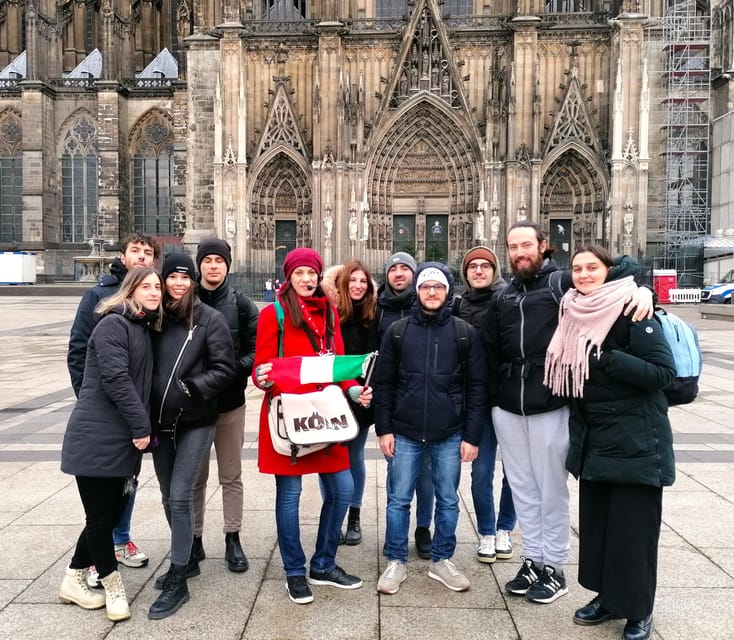
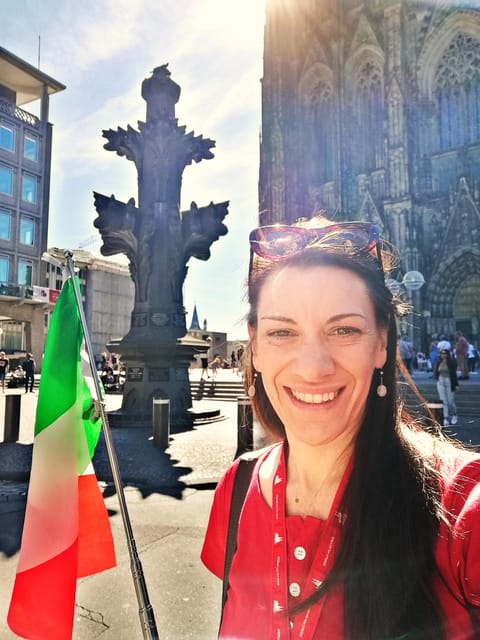
The meeting point is beside a copy of the cathedral’s large pinnacle. This is an important detail because the cathedral square is broad and busy, and a clear landmark makes the group easier to find. Look for the pinnacle copy rather than simply waiting somewhere near the cathedral doors.
The cathedral is the natural opening scene. Its height can make the first few minutes feel like a lesson in scale. The route uses the building not only as a famous church but also as a marker of Cologne’s long religious and civic importance.
The description identifies it as the last Gothic cathedral, and the guide places it within the story of the ancient colony that came before it. That approach is more useful than treating the cathedral as an isolated photo stop. You begin to see how a modern city grew around an old center.
This portion is mainly an exterior introduction to the city’s setting and past. If entering the cathedral is a priority, allow separate time for that, since the tour information does not promise a dedicated interior visit.
Roman Cologne near the cathedral square
The first historical layer is Roman. Cologne’s ancient name and early development are tied to its Roman origins, and the Roman Arch offers a physical reminder of that beginning.
I appreciate starting here because it gives you a base for everything that follows. The later medieval streets can seem like a separate world, but the Roman foundation explains why this spot became such an important urban center. Sara’s job is to make that early period understandable through facts and stories rather than leaving you with a date or a ruin and no context.
This is also where historical images become useful. A photograph of an earlier street or building can show how much has been altered, rebuilt, or lost. You are not simply looking at old stones. You are comparing several versions of Cologne in the same location.
The Roman material is part of a fast-moving route, so anyone wanting a specialist archaeological tour should choose a more focused experience. For a first visit, though, this short introduction gives you the essential starting point.
Medieval squares, merchants, and the town hall
From the cathedral area, the route heads into the old town. The walk through squares and alleys shifts the mood from Roman settlement to medieval Cologne, when the archbishop and the free city of merchants competed for influence.
The Town Hall and its splendid tower represent the civic pride of that merchant city. Alter Markt adds a broad public square to the story, while Heumarkt helps you understand how the old center functioned as a place of trade, movement, and public life.
The value here is in the connection between buildings and power. The town hall is not just an attractive monument. It points to the political strength of Cologne’s citizens and their desire to govern their own commercial city. The archbishop’s role provides the other side of that story.
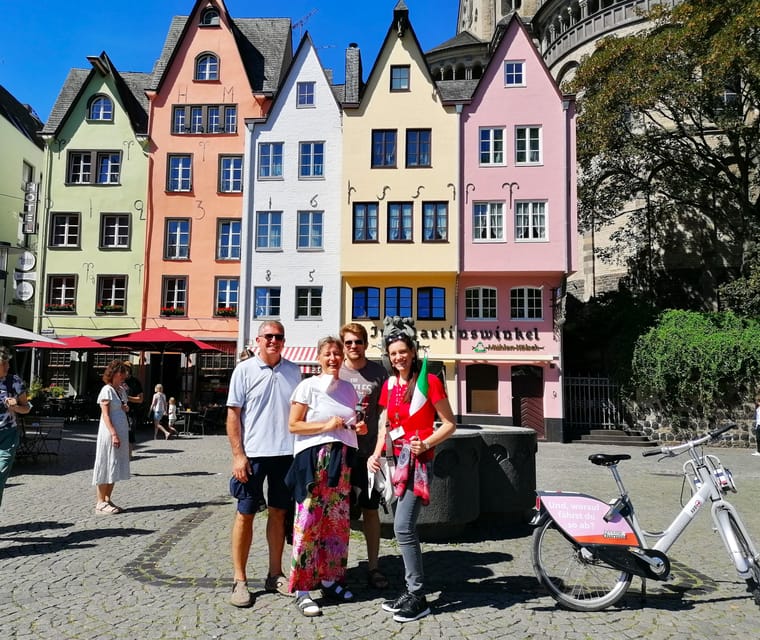
Great St. Martin adds a strong visual note, with its distinctive church form close to the old town and Rhine. Fischmarkt then brings you toward the river, where colorful houses create one of Cologne’s most recognizable scenes.
Do not expect a long stop inside each church or building. The route covers several major sights in a limited time. You will see the exteriors, hear why they matter, and get a better sense of how the medieval center fits together.
A few more Cologne half-days to weigh up
- Cologne: Panoramic City Cruise
★ 4.3 · 5,698 reviews - Cologne: Brewery Tour with 3 Kölsch Beer Tastings
★ 4.7 · 3,108 reviews - Cologne: Top Sights Rhine River Cruise – Skyline Tour
★ 4.4 · 3,030 reviews - Cologne: Chocolate Museum Entrance Ticket
★ 4.4 · 2,790 reviews
Fischmarkt and the Rhine promenade
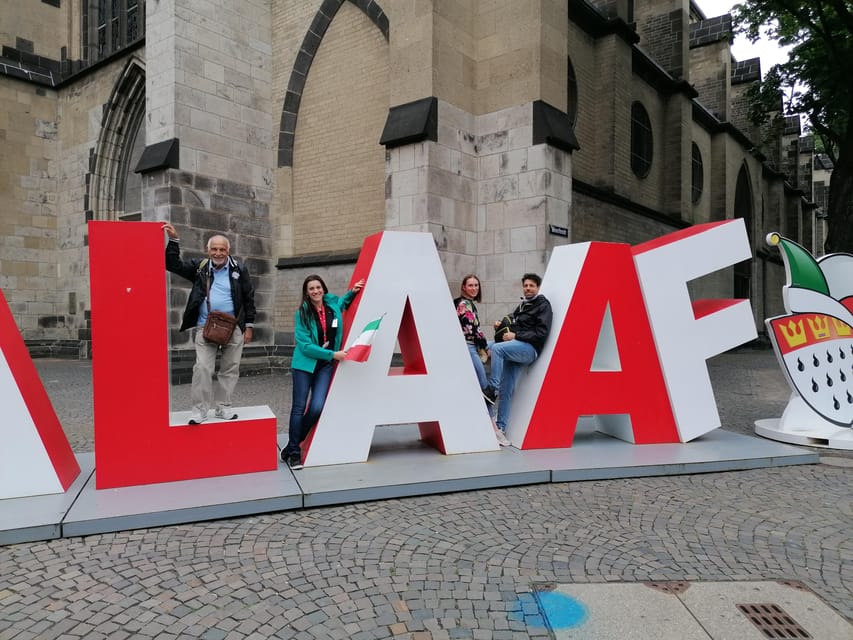
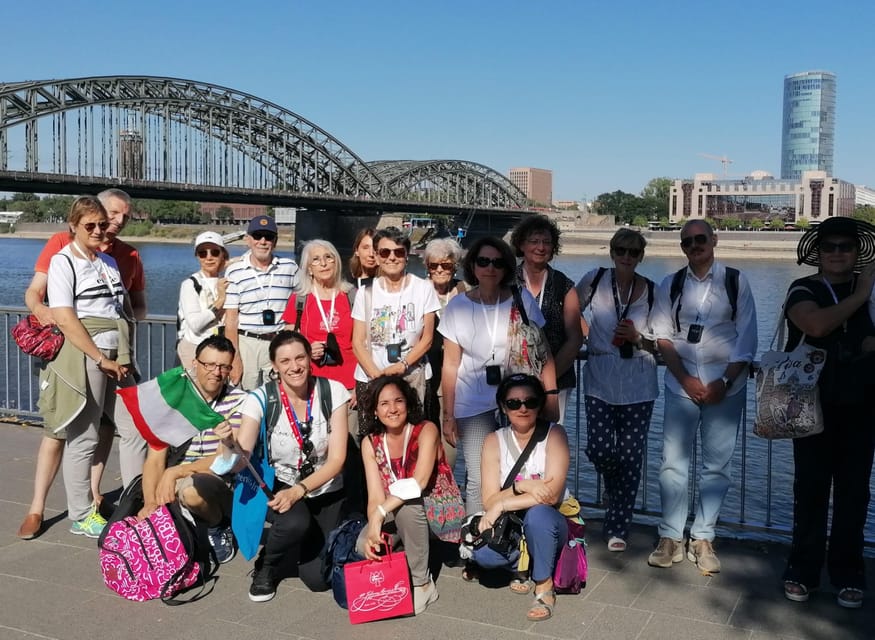
The Rhine section gives the walk some breathing room. After the close streets and squares of the old town, the river opens the view and helps you understand Cologne’s position as a trading city.
The route passes historic breweries and the colorful houses around Fischmarkt before continuing along the Rhine promenade. These places are valuable because they connect the grand historical story with ordinary city life. Cologne’s old town is not only made up of churches and official buildings. It also has drinking halls, homes, shops, and river-facing streets that still shape the way people experience the center.
The brewery references are especially useful if you plan to explore Cologne’s food and drink culture later. The tour does not include a brewery meal or tasting, so treat this part as an introduction and make your own plans afterward.
The river walk also offers a change in pace. If you want a tour made entirely of famous monuments, this section may feel less packed. I see that as a strength. It gives you a chance to notice the relationship between the historic center and the Rhine instead of racing from one landmark to the next.
Salzgasse, old streets, and Cologne’s small details
Salzgasse is one of the more intimate parts of the route. Streets like this help fill in the gaps between the major sights. A cathedral or town hall can explain power and religion, but a narrow old street gives you a sense of how the city’s spaces were arranged at a human level.
This is where the guide’s anecdotes and trivia matter most. The tour is designed to include facts that are not always obvious from a monument plaque. Sara’s approach, based on the information provided, combines formal history with small details and answers to questions along the way.
That makes the walk a good fit if you prefer a guide who feels approachable rather than distant. Several comments about Sara describe her as prepared, friendly, available, and easy to talk to. That is useful when you want to ask about a building, a local custom, or what to see after the tour.
Still, a two-hour walk has limits. The route can introduce Salzgasse and the surrounding old town, but it cannot explain every lane, house, or guild tradition in depth. Think of it as a well-chosen sample rather than a full study of Cologne’s historic streets.
Cologne’s perfume story at Farina and 4711
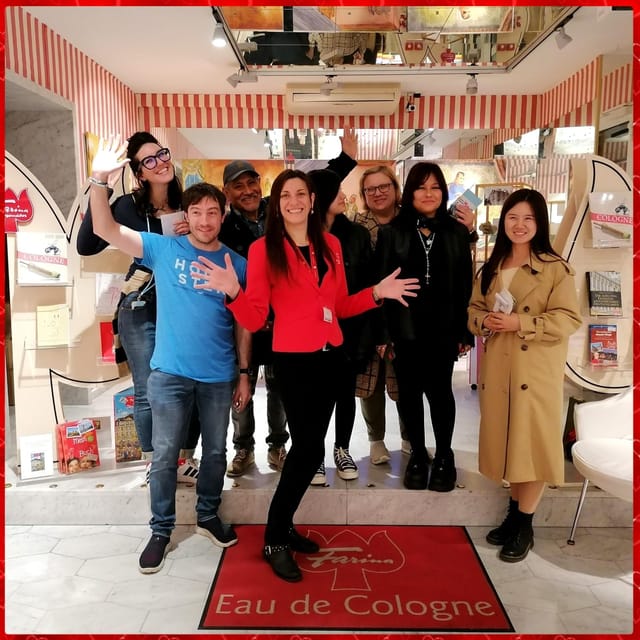
The perfume stops add a welcome change from churches, ruins, and political history. Eau de Cologne Farina and Eau de Cologne 4711 show how a product became linked to the city’s name around the world.
At Eau de Cologne Farina, you encounter one part of that story. At 4711, you see another famous name associated with Cologne water. The tour brings both into the same route, which helps you understand that the city’s perfume identity has more than one chapter.
This is one of the most memorable parts for many first-time visitors because it is unexpected. You may arrive thinking the tour will focus only on Roman remains and the cathedral. Instead, you get a practical piece of commercial history and a sensory subject that is easy to remember.
The tour does not state that perfume samples, purchases, or an interior visit are included. Plan on learning about the brands and their place in Cologne’s history, not on receiving a product experience as part of the ticket.
Opera, Kolumba, and the scars of the Second World War
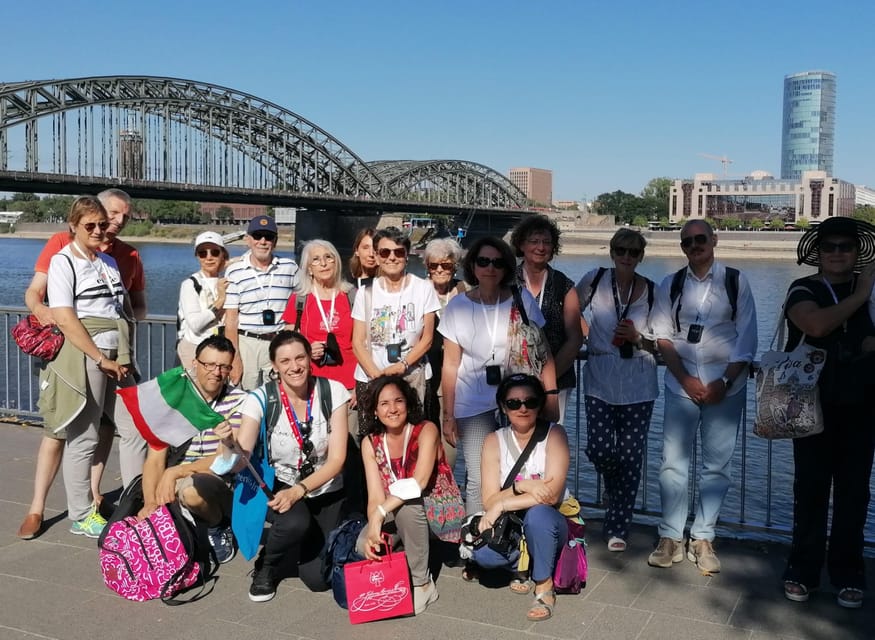
The final section turns toward modern Cologne. Historical images help compare past and present, with special attention to the wounds left by the Second World War and the effort to rebuild the city afterward.
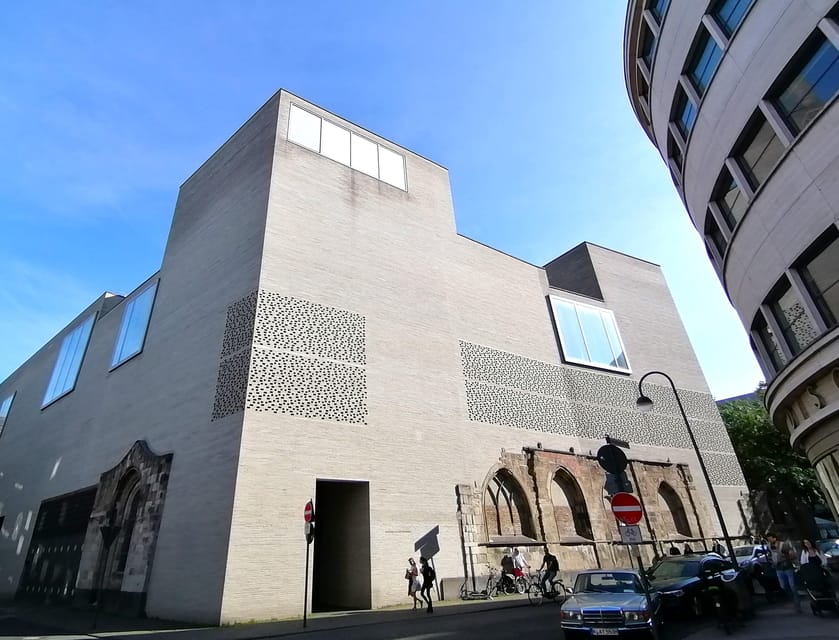
The Opera district and Kolumba district are important because they show that reconstruction is not a simple return to the past. Cologne had to decide what to restore, what to replace, and how to build a modern city among surviving fragments and memories.
Kolumba is particularly useful in this discussion because it links older religious and artistic traditions with newer architecture. The route does not promise a museum visit, so you should think of this as an outdoor explanation of the district and its development.
The Opera area adds another layer of modern civic life. Together, these stops keep the tour from becoming a postcard walk through an untouched old town. Cologne’s center was heavily affected by war, and the present-day city reflects both loss and rebuilding.
I value this part because it gives you a more honest view of Cologne. The city is attractive, but its appearance is also the result of destruction, reconstruction, and modern choices. Historical photographs make that contrast easier to grasp than a spoken explanation alone.
Sara’s Italian-language guiding style
The tour is conducted in Italian by Sara, a professional guide certified by the tourist board. For Italian-speaking visitors, this is the main reason to choose this particular walk.
A native Italian-speaking guide can explain difficult historical links, wordplay, and local references without forcing you to work through a second language. That matters in a tour filled with names, political changes, religious institutions, and stories from different periods.
Sara is also described as prepared, friendly, and willing to answer questions. Those qualities are more useful than a long list of credentials. You want a guide who can keep the route moving while still stopping to deal with genuine curiosity.
The strongest praise centers on her preparation, personal manner, historical anecdotes, and use of old photographs. One useful detail is that she has other tours available, so you can ask her about further ways to explore Cologne if you have more time.
The language choice is also the main limitation. If you do not understand Italian, this is not the right tour for you. The available language is Italian only.
Timing, access, and the right expectations
The walk lasts two hours. That is long enough to cover the central sights but short enough to fit into a busy Cologne schedule. I would place it near the beginning of your stay, when the route can help you choose where to return later.
The tour is wheelchair accessible, which makes the central itinerary more practical for many visitors. Specific surface conditions, restroom arrangements, and interior access are not provided, so ask the provider if you need details beyond general wheelchair accessibility.
Starting times vary, so you need to check availability before booking. The meeting point is at the cathedral’s pinnacle copy, and the route includes outdoor streets, squares, the Rhine promenade, and historic districts. Dress for a walking tour and keep your schedule flexible enough to finish at the stated two-hour length.
Cancellation is free up to 24 hours before the start time, with a full refund. You can also reserve now and pay later. Those terms are useful if your Cologne plans are still changing, though you should still check the current booking conditions at the time you reserve.
Who should book this Cologne walk
I would choose this tour if you want a short, structured introduction in Italian and you care about more than the cathedral alone. It suits first-time visitors, couples, families, and anyone who likes history delivered through real places rather than a long classroom-style talk.
It is also a good match if you enjoy small stories. The route includes major landmarks, but the promise of trivia, anecdotes, historical images, and insider tips gives it a more personal feel than a simple checklist walk.
You may want something else if you prefer a slow visit to one monument, a food tour, a brewery tasting, or a museum-led experience. The itinerary is broad, so each stop receives an introduction rather than a prolonged examination.
At $23, I consider it good value for a certified professional guide and a two-hour route through Cologne’s most important central areas. The price is especially fair when you use the walk to plan the rest of your stay.
Should you book it?
Book this tour if you speak Italian and want to understand how Roman Cologne, the medieval merchant city, the Rhine, perfume makers, wartime destruction, and modern reconstruction fit together. Sara’s friendly manner, historical photographs, and willingness to answer questions add value beyond simply pointing out buildings.
Skip it if you need an English-language tour, extensive interior visits, or a specialist focus on only one period. For a first look at Cologne, though, this is a practical and lively two-hour orientation with a clear route and a strong sense of place.
FAQ
Where does the tour meet?
The meeting point is at a copy of the large pinnacle of Cologne Cathedral.
How long does the walking tour last?
The tour lasts two hours.
What language is the tour conducted in?
The live tour is conducted in Italian.
Who guides the tour?
The guide is Sara, a professional guide certified by the tourist board.
How much does the tour cost?
The listed price is $23 per person.
Is the tour wheelchair accessible?
Yes, the activity is listed as wheelchair accessible.
Which major sights are included?
The route includes the Roman Arch, Cologne Cathedral, Town Hall, Alter Markt, Groß Sankt Martin, Fischmarkt, the Rhine promenade, Salzgasse, Heumarkt, Eau de Cologne Farina, Kolumba, the Opera, Eau de Cologne 4711, and Wallrafplatz.
Does the tour cover Cologne’s Roman past?
Yes. The walk begins near the cathedral square and introduces the Roman origins of the ancient colony.
Does the tour include the Second World War and reconstruction?
Yes. The route discusses wartime destruction, postwar memory, reconstruction, and the development of the modern city, especially around the Opera and Kolumba districts.
Can I cancel for a full refund?
Yes. You can cancel up to 24 hours in advance for a full refund.
Just added around Cologne
- From Amsterdam: Cologne Private Sightseeing Tour★ 5.0 · 4 reviews
- Cologne: entertaining guided tour to old town highlights★ 4.8 · 22 reviews
- Cologne: WWII Sites with Optional EL-DE Haus Private Tour★ 4.9 · 22 reviews
- Cologne: Virtual escape game adventure at 7th Space★ 4.3 · 15 reviews
- Cologne Walking Tour: The essential and unmissable one★ 4.3 · 10 reviews
- Cologne: The Dark Side of the City Walking Tour★ 4.8 · 142 reviews
- Cologne: Ehrenfeld District Street Art Walking Tour★ 4.9 · 202 reviews
- Cologne: Street Art Walking Tour in the Ehrenfeld District★ 4.9 · 45 reviews
Cologne Tours, compared.

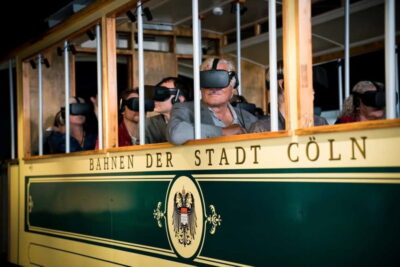
Virtual Reality Time Travel Experience Ticket
Read our review →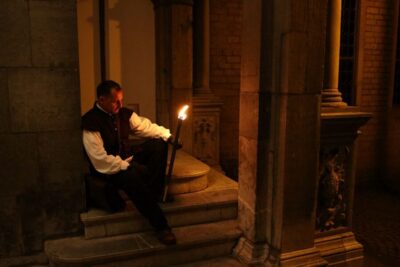
The Night Watchman Old Town Walking Tour in German
Read our review →Browse the lists this tour appears in