
Review · KOBLENZ TOURS
Koblenz – Old Town with the Ehrenbreitstein Fortress
Ehrenbreitstein Fortress gives you the best opening view of Koblenz: the Rhine below, the city across the water, and the meeting point of the Rhine and Moselle ahead. I like that this private three-hour tour combines the fortress with a compact walk through the Old Town, rather than making you choose between the city and its hilltop landmark. I also like the flexible morning, afternoon, or evening start times and the undivided attention of a licensed guide.
The main caution is timing. One review reports that the guide said there would not be enough time to cover both the fortress and Old Town as described, though an effort was made to do both. You should confirm the plan before arrival, especially since fortress admission and the cable car are extra.
Key points to know before booking
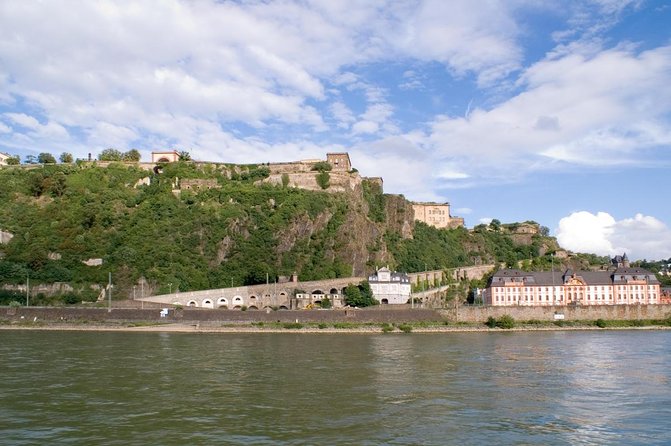
- Ehrenbreitstein opens the tour with wide Rhine Valley views, but admission and the cable car ticket are not included.
- The route ends at Deutsches Eck, making it a useful introduction to Koblenz rather than a return-trip excursion.
- You get a private guide for your own group, with no other booking party joining you.
- The Old Town walk covers major landmarks quickly, including Münzplatz, Liebfrauenkirche, St. Castor Basilica, and Schängelbrunnen.
- The advertised three hours require a sensible pace, so clarify how much time will be spent inside the fortress.
- The tour suits independent sightseeing plans, since you can choose a morning, afternoon, or evening departure.
Starting above Koblenz at Ehrenbreitstein Fortress
The tour begins at Ehrenbreitstein Fortress, across the Rhine from central Koblenz. The fortress sits about 118 meters above the river, and its position explains its purpose at once. From this height, you can see why this ridge was chosen to guard the Middle Rhine.
The present fortress complex was built between 1817 and 1828 as part of a major defensive system. It is described as the second-largest fortress in Europe. That scale matters when you visit. This is not a single lookout tower or a quick photo stop. You are entering a large military site with walls, defensive works, and open areas that take time to explore.
The cable car connects the fortress with the city below. It is a practical way to cross the river and gives you a memorable approach to the site, but you must pay for the ticket yourself. Transportation costs are not included in the tour price, so add that expense when comparing this outing with other guided walks.
The fortress also carries a literary footnote. Lord Byron described Ehrenbreitstein in a poem after seeing its damaged, blackened walls. The reference points to the fortress’s long military past and its role in wars involving France and German states. Your guide can give that setting more meaning than a sign beside the entrance.
The supplied schedule allows about one hour and 20 minutes at Ehrenbreitstein. That is enough for a guided look at the main areas and the views, but it is not a leisurely half-day fortress visit. If you want time for every courtyard, exhibit, and viewpoint, ask how the guide plans to divide the three hours.
More old town walks in Koblenz:
- Koblenz: Old Town Sightseeing Cruise along the Rhine
★ 4.5 · 305 reviews - Koblenz – Old Town including the Deutsches Eck
★ 4.5 · 16 reviews - Koblenz: Old Town Tour with the Ehrenbreitstein Fortress
★ 4.8 · 4 reviews
Taking in the Rhine Valley from the fortress
The view is the strongest reason to begin here. From Ehrenbreitstein, you look down on Koblenz and across the Rhine toward the city center. The tour’s location within the UNESCO-listed Rhine Valley gives this opening stop a wider setting than an ordinary city walk.
You can also see the geographical reason for Koblenz’s importance. The city grew at the meeting of two major rivers, and the name Koblenz comes from the Roman Castellum apud confluentes, meaning a fort at the confluence. That idea returns at the end of the tour at Deutsches Eck.
I like this high-to-low route. You begin with the broad picture, then move into the close streets, churches, fountains, and squares of the Old Town. It gives the rest of the walk a clear frame. You are not simply collecting monuments. You are seeing how the city’s military position, river trade, Roman roots, and civic life fit together.
The physical demands are moderate but real. You will spend time walking through a large fortress, then continue through the city. The tour requires a moderate fitness level, and the hilltop start, walking route, and cable car connection are worth keeping in mind if you have mobility concerns.
Münzplatz and the Roman beginning of Koblenz
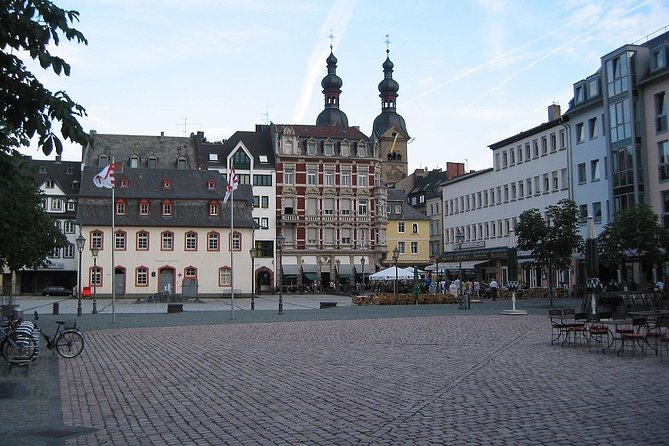
After the fortress, the route reaches Münzplatz in the Old Town. The square’s name comes from the electoral coin, or Münz, minted here in the 11th century. That small detail gives the place a useful link to Koblenz’s role as an administrative and economic center.
Münzplatz is also tied to the Roman foundation of the city. The Romans established Castellum apud confluentes here, a fort at the meeting of the rivers. You can think of the square as a compact history lesson: Roman military roots, medieval coin production, and modern civic life all meet in one urban space.
A fountain built for Koblenz’s 2,000-year anniversary in 1992 adds a more recent layer. It was created by Wili Heinzen and given to the city and its residents by Sparkasse Koblenz. The stop lasts about 15 minutes, so your guide will likely focus on the square’s story and visible details rather than offer a long break.
This is one reason a private guide helps. You can ask how the Roman fort shaped later Koblenz, or how the square changed over time. In a larger group, a short stop like this can become a quick photograph and a name you forget. With your own guide, you have a better chance to connect the details.
Liebfrauenkirche and Koblenz’s church quarter
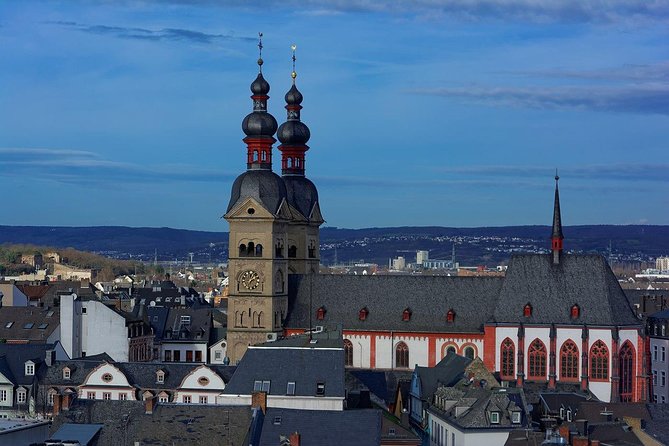
From Münzplatz, the walk enters a romantic street between two churches. Liebfrauenkirche is easy to identify by its onion domes and its position on the highest point of the city. It served as one of Koblenz’s main parish churches during the French Revolution.
The church dates to the 17th century, but its story includes major destruction. It was destroyed in 1944 and rebuilt in 1955. That rebuilding is important context for what you see. The church represents both the older city and the damage Koblenz suffered during the Second World War.
The schedule allows around 15 minutes here. Treat it as a focused exterior and history stop unless your guide tells you that interior access is available. The tour information does not promise entry, so you should not assume that a full church visit is part of the plan.
I like the way this stop follows Münzplatz. The square explains the city’s beginnings, while Liebfrauenkirche shows how Koblenz developed into a medieval and early modern town. The short walk between the churches also gives you a change of pace from the open fortress grounds.
A few more Koblenz half-days to weigh up
- Koblenz: Rhine Valley Castles and Palaces Boat Tour
★ 4.4 · 1,824 reviews - Koblenz: 2-Hour Sightseeing Cruise on the Rhine
★ 4.6 · 839 reviews - Koblenz: Panoramic Cruise on Moselle River to Winningen
★ 4.4 · 283 reviews - Koblenz: Rhine Valley Castle Sightseeing Cruise
★ 4.6 · 98 reviews
St. Castor Basilica, Koblenz’s oldest church
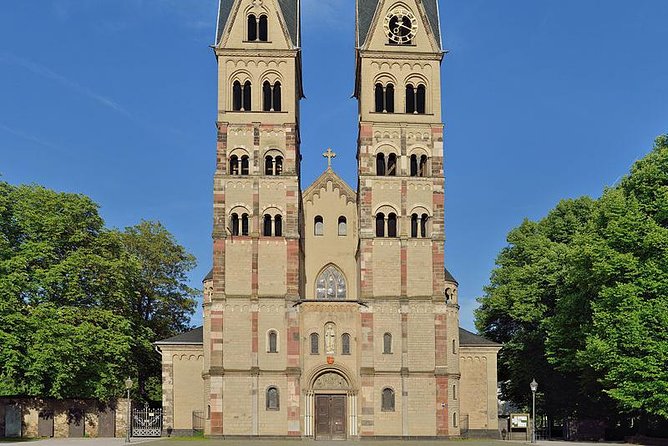
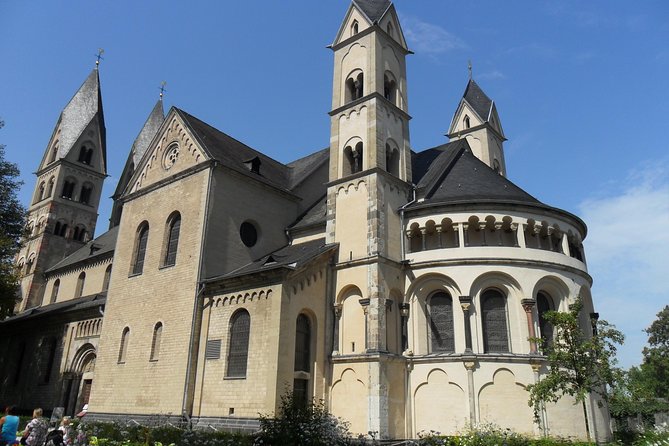
The next church is the Basilica of St. Castor, identified as the oldest church in Koblenz. The Archbishop of Trier built it between 817 and 836 with support from Emperor Louis the Pious. It began as a Carolingian proprietary church, placing it firmly in the early medieval period.
That date makes St. Castor especially valuable in a three-hour tour. You are not only seeing a pretty church facade. You are looking at a building connected to the political and religious structure of the Carolingian world, when bishops and emperors helped shape the towns along the Rhine.
The planned stop is another 15 minutes. You will need to keep moving, but the church gives your guide a chance to explain Koblenz before the modern German state existed. I would listen for the link between the Archbishop of Trier, the rivers, and the city’s position in the Middle Rhine region.
As with Liebfrauenkirche, entry is not clearly promised. The only specifically stated admission charge is for Ehrenbreitstein Fortress, but the tour’s short schedule means you should ask about church access if that matters to you.
Schängelbrunnen and the character of Koblenz
Schängelbrunnen sits near the city hall and offers one of the tour’s lighter stops. The word Schängel comes from Koblenz’s 20-year allegiance to France, from 1794 to 1813. The fountain was designed by Carl Burger in 1940 and dedicated to the poet Josef Cornelius.
This is a good place to understand local identity. Koblenz was shaped by French rule, German politics, river connections, and a strong civic sense. The fountain is regarded as a symbol of the city, so it works as more than a decorative pause.
The stop lasts about 15 minutes. That gives you enough time to see the fountain, hear the story behind the name, and take a few photographs. It also breaks up the church-heavy middle part of the route before the final walk to the river confluence.
I appreciate stops like this because they make a city feel specific. A fortress and a basilica could appear on many European itineraries. A local nickname tied to a period of French rule tells you something you could easily miss by walking alone.
Finishing at Deutsches Eck and the Kaiser Wilhelm memorial
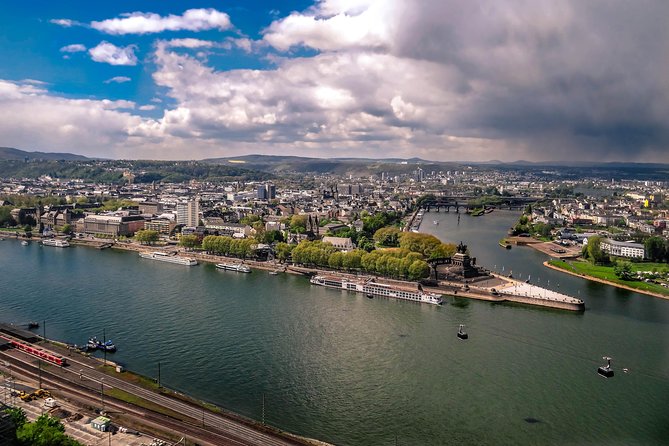
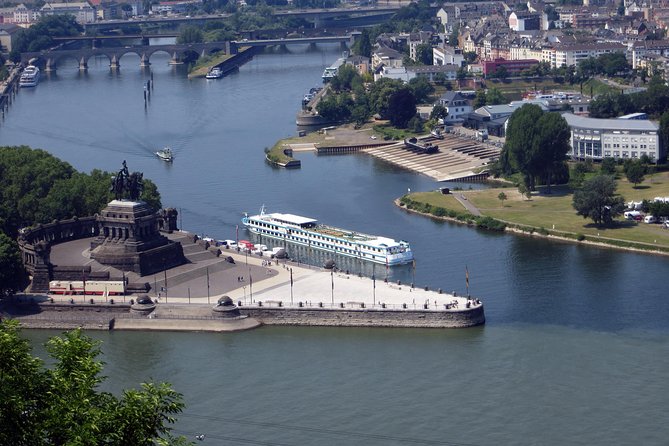
The tour ends at Deutsches Eck, the headland where the Rhine and Moselle meet. The name means German Corner, and the site is one of Koblenz’s most recognizable public spaces.
The Kaiser Wilhelm memorial was erected in 1897 for the first German Emperor. Its size and position reflect the nationalism of the late 19th century. Your guide can help place the monument in the political period that produced it, rather than leaving it as a large statue beside the water.
The planned visit lasts about 20 minutes. That is enough for the confluence, the memorial, and photographs along the river. Since the tour ends here, you are well placed to continue exploring Koblenz on your own, but you must arrange your own return to the starting side of the river if needed.
The ending is also practical. You finish with one of the city’s major sights instead of retracing the whole route back to Ehrenbreitstein. If you have a train, hotel, or evening plan in central Koblenz, ask your guide how the endpoint fits your schedule.
What $438.73 means for a private group
The price is $438.73 per group of up to 15 people. That makes the value depend heavily on group size. For 10 to 15 people, the per-person cost can be reasonable for a private guide. For one or two people, it is a much more expensive way to see Koblenz than joining a shared walking tour or exploring independently.
You are paying for a licensed guide and a private experience, not for admission to the fortress or transportation. The price does not include the cable car ticket, fortress entry, or other transportation costs. Keep those additions in your budget before you decide.
The private format has a clear advantage for families, friends, and cruise or event groups. You can hear the guide without competing with another party, ask questions, and set a pace that works for your group. It may also be useful if you need the tour to begin at a particular time, since morning, afternoon, and evening departures are offered.
The tradeoff is the tight schedule. A private guide cannot create more than three hours, and the fortress alone is allocated about 80 minutes. If the group wants a slow fortress visit plus a detailed Old Town walk, the plan may feel rushed.
One German-language review describes the guide as friendly, funny, and informative. That is the kind of guiding style this route needs. The tour covers many dates and names in short order, so a clear and lively explanation will make a real difference.
The timing issue you should settle before arrival
The most important practical point is the possible mismatch between the advertised route and the time available. One booking experience resulted in a guide explaining that there would not be enough time to visit both the fortress and the Old Town as expected. The guide tried to rearrange the route, but the concern remained.
I would contact the operator before the tour and ask three direct questions:
- Is the full fortress visit included in the same three hours as all six Old Town stops?
- How long will the group spend inside Ehrenbreitstein?
- Is the cable car ride included in the timing, and who buys the tickets?
These questions are especially important for a group arriving by ship, train, or timed excursion. If your priority is the fortress, say so. If the Old Town matters more, ask whether the fortress visit will be a short orientation rather than a full tour.
The route can work well if you treat it as a highlights tour. It becomes less suitable if you expect detailed interiors, long stops, and relaxed photography at every site.
Practical details for a smoother visit
You receive booking confirmation at the time of reservation, and the meeting point is Greiffenklaustraße at Ehrenbreitstein Fortress. The endpoint is Deutsches Eck on Konrad-Adenauer-Ufer.
The tour is near public transportation, but the listed price does not cover transportation. Plan the route to the fortress and the return from Deutsches Eck before the day begins. The cable car is the obvious connection between the fortress and Koblenz, but its ticket is an additional charge.
Choose your start time according to your priorities. A morning departure leaves more of the day for independent sightseeing. An afternoon start may fit a later arrival, while an evening departure could give the Old Town a different atmosphere. The tour requires good weather. If poor weather causes cancellation, you are offered another date or a full refund.
For everything else, the cancellation rule is strict. The booking is non-refundable and cannot be changed for any reason. That makes weather protection helpful, but it does not cover a change in your own plans.
Who will get the most from this Koblenz tour
I would recommend this experience to a group that wants a private introduction to Koblenz and has only a few hours. It is especially useful if you want both the hilltop fortress and the central Old Town without planning the route yourself.
It also suits people who enjoy context. The Roman fort, medieval coin mint, Carolingian church, French connection, imperial monument, and Rhine setting give the guide plenty to explain. You will get more from the walk if you ask questions and accept that each stop is a highlights visit.
I would be cautious if you are traveling alone or as a couple and are focused on value. The group price can be hard to justify for a small party, particularly after adding admission and cable car costs.
I would also reconsider if you want a slow, detailed fortress tour. The schedule is ambitious, and the timing concern deserves attention before booking.
Should you book it?
Book this tour if you have a private group, want a licensed guide, and value seeing Ehrenbreitstein Fortress and the Old Town in one compact outing. The Rhine views, Roman foundations, old churches, Schängelbrunnen, and Deutsches Eck form a sensible first look at Koblenz.
Before paying, confirm exactly how the three hours are divided and budget for the fortress and cable car tickets. If the operator can confirm that both sections receive the attention you want, this can be a useful and personal introduction to the city. If not, choose either a dedicated fortress visit or a longer Old Town walk so that neither part feels squeezed.
FAQ
Where does the tour begin?
The tour begins at Ehrenbreitstein Fortress on Greiffenklaustraße, 56077 Koblenz, Germany.
Where does the tour end?
The tour ends at Deutsches Eck on Konrad-Adenauer-Ufer, 56068 Koblenz, Germany.
How long is the experience?
The tour lasts approximately three hours.
How many people can join the private tour?
The price covers one private group of up to 15 people. Only your group participates.
Is a guide included?
Yes. A licensed guide is included.
Are fortress admission and the cable car included?
No. Admission to Ehrenbreitstein Fortress and the cable car ticket are not included. Transportation costs are also excluded.
Can I choose the departure time?
Yes. Morning, afternoon, and evening departure times are available.
Is the tour suitable for people with limited fitness?
The experience requires a moderate level of physical fitness. The route includes a hilltop fortress and a walking tour through Koblenz.
What happens if bad weather cancels the tour?
The experience requires good weather. If it is canceled because of poor weather, you are offered a different date or a full refund. Otherwise, the booking is non-refundable and cannot be changed.
Just added around Koblenz
- e-Scavenger hunt Koblenz: Explore the city at your own pace★ 4.0 · 20 reviews
- Koblenz Guided tour of the Ehrenbreitstein Fortress★ 4.5 · 7 reviews
- Koblenz – Old Town including the Deutsches Eck★ 4.5 · 16 reviews
- Koblenz: Private pub crawl with insider guide & free shots★ 5.0 · 5 reviews
- Koblenz: The Living Vineyard, Nature & Wine Enjoyment★ 5.0 · 14 reviews
- Koblenz: Rhine Valley Castle Sightseeing Cruise★ 4.6 · 98 reviews
- Koblenz: Sunset Boat Cruise★ 4.6 · 80 reviews
- Koblenz: Christmas Boat Tour with Mulled Wine★ 4.3 · 35 reviews
Koblenz Tours, compared.


Browse the lists this tour appears in