
Review · KOBLENZ TOURS
Koblenz – Old Town including the Deutsches Eck
Koblenz packs a surprising amount of German history into a short walk. This private tour links the Roman roots of Münzplatz with the grand riverside memorial at Deutsches Eck, giving you a clear first look at the city without a long day on your feet. I especially like the logical route and the chance to ask questions in a group of your own.
I also like the two-hour length, which fits neatly into a cruise stop or a free morning. The English option and several daily start times make planning easy. The main consideration is price: at $420.53 per group, it is good value for a larger party, but costly for one or two people.
Key points to know before you book
- Roman beginnings at Münzplatz: Start where Koblenz’s story reaches back to the Roman fort called Castellum apud confluentes.
- A compact Old Town route: Visit two major churches, a symbolic fountain, and the city’s best-known meeting point with the Rhine and Moselle.
- Private attention: Only your group takes part, with space for up to 15 people.
- A strong final view: End at Deutsches Eck and the Kaiser Wilhelm memorial rather than returning to your starting point.
- Simple planning: The tour lasts about two hours, is offered in English, and includes a mobile ticket.
- Best value for groups: The flat group price makes more sense when shared among several people than when booked by a couple.
Why this Koblenz walk works for a first visit
Koblenz is one of those cities where the old center, churches, riverfront, and major monuments sit close together. That makes a guided walk useful. You can see the main sights without spending time working out the route, and the guide can connect the pieces instead of leaving you with a series of pretty buildings and unfamiliar names.
The route begins in Münzplatz and finishes at Deutsches Eck. That direction matters. You start with the city’s early Roman story, move through its medieval and later religious landmarks, then finish with the large-scale imperial monument where the Rhine and Moselle meet. In two hours, you get a broad introduction rather than a narrow look at one building.
I would treat this as an orientation walk, not a full study of Koblenz. The schedule gives about 15 minutes at each of the first four stops and 35 minutes at Deutsches Eck. That is enough for explanation, photos, and a first impression, but not enough for lengthy interior visits or an unhurried museum stop.
More old town walks in Koblenz:
- Koblenz: Old Town Sightseeing Cruise along the Rhine
★ 4.5 · 305 reviews - Koblenz – Old Town with the Ehrenbreitstein Fortress
★ 4.0 · 7 reviews - Koblenz: Old Town Tour with the Ehrenbreitstein Fortress
★ 4.8 · 4 reviews
Münzplatz and the Roman foundation of Koblenz
Münzplatz is a good starting point because it ties the present-day Old Town to the city’s earliest recorded roots. The square takes its name from the electoral coin called Münz, minted here in the 11th century. That small detail helps explain why the square is more than a convenient meeting point.
The Roman connection reaches back further. Koblenz owes its name to Castellum apud confluentes, meaning a fort at the confluence. The Romans established their fort here because of the meeting of the Rhine and Moselle, the same geographic fact that gives Deutsches Eck its importance later in the walk.
You will also see the fountain built for Koblenz’s 2,000-year anniversary in 1992. Wili Heinzen designed it, and Sparkasse Koblenz gave it to the city and its residents. The stop lasts about 15 minutes, so expect a concise explanation rather than a long architectural reading of the square.
I like beginning here because it gives you a useful question to carry through the rest of the tour: how did a settlement at two rivers become the Koblenz you see today? If you arrive early, Münzplatz is also an easy place to get your bearings before the walk begins.
Liebfrauenkirche and the street between two churches
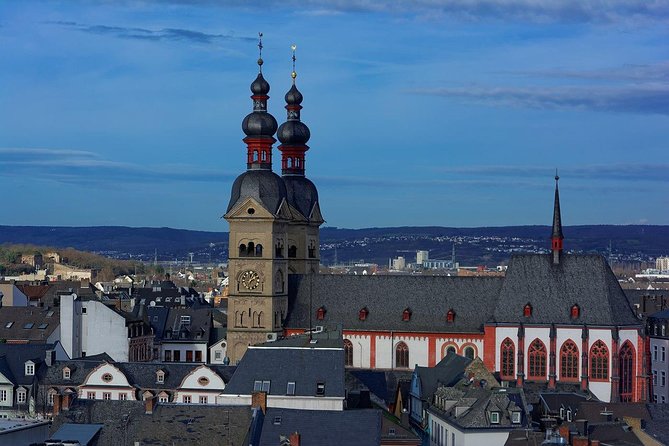
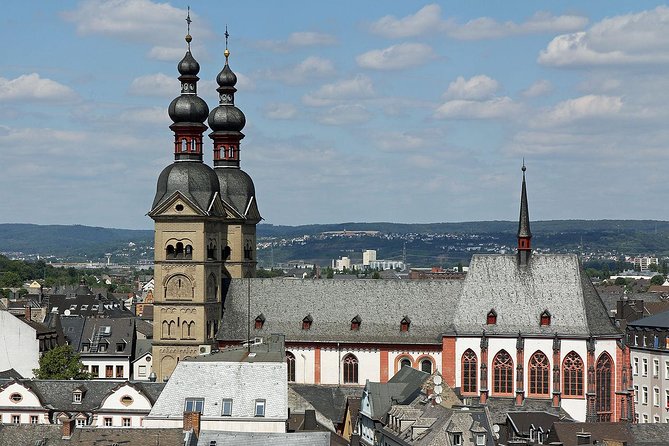
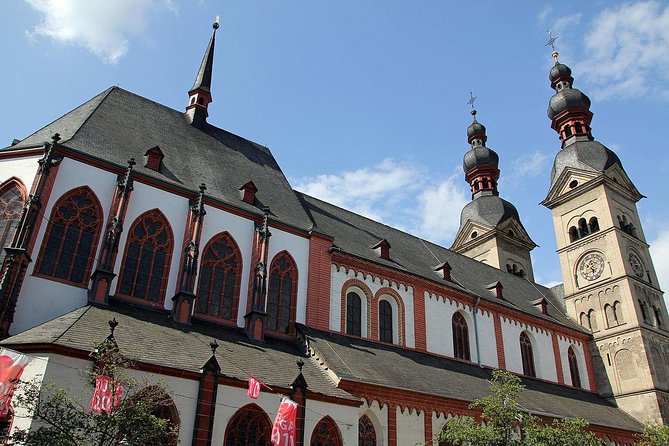
From Münzplatz, the walk continues toward Liebfrauenkirche. This church sits at the highest point of the city and is recognizable by its onion domes. The route between Liebfrauenkirche and St. Castor is described as a romantic street, so this portion gives you a change of pace from the open square.
The church was built in the 17th century and served as one of Koblenz’s main parish churches during the French Revolution. It was destroyed in 1944 and rebuilt in 1955. That sequence is important because it shows how much of the city’s appearance reflects both older foundations and postwar rebuilding.
You should expect around 15 minutes here. The tour information does not promise an interior visit, so plan on learning about the church and seeing it as part of the Old Town route rather than assuming you will have time for a detailed look inside.
For me, this is one of the stops where a guide adds real value. Onion domes are easy to photograph, but the story of the church’s destruction and reconstruction gives the building more weight. It also keeps the tour from presenting Koblenz as a perfectly preserved medieval town. Parts of the city are old, while other parts were rebuilt after wartime damage.
Basilica of St. Castor, Koblenz’s oldest church
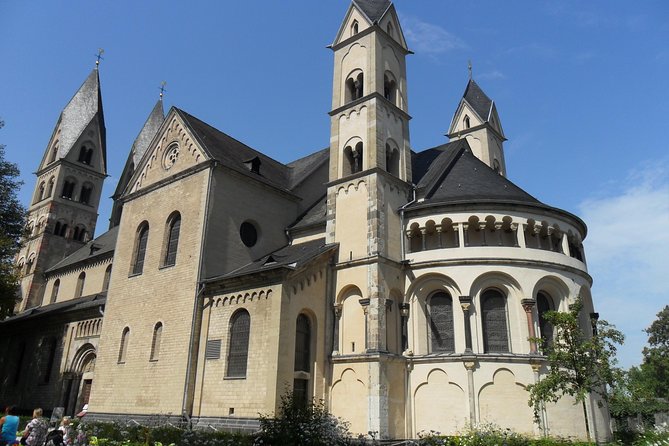
The Basilica of St. Castor is the oldest church in Koblenz and one of the major historical stops on the walk. Its construction took place between 817 and 836, under the Archbishop of Trier and with the support of Emperor Louis the Pious. It was built as a Carolingian proprietary church.
That date places the basilica in the early medieval period, long before the later buildings and monuments along the route. You do not need a specialist interest in church architecture to appreciate the stop. The key point is simple: this is where the city’s religious and political importance becomes visible in stone.
The schedule allows about 15 minutes. That is enough for an introduction to the basilica’s age and role, but you should not expect a deep architectural lecture or a long period of quiet exploration. The tour works best when you listen for the broad story and note places you may want to revisit later.
I like the contrast between Liebfrauenkirche and St. Castor. One tells a story of rebuilding after destruction, while the other connects you to the Carolingian period. Together, they make the Old Town feel layered rather than just old.
A few more Koblenz half-days to weigh up
- Koblenz: Rhine Valley Castles and Palaces Boat Tour
★ 4.4 · 1,824 reviews - Koblenz: 2-Hour Sightseeing Cruise on the Rhine
★ 4.6 · 839 reviews - Koblenz: Panoramic Cruise on Moselle River to Winningen
★ 4.4 · 283 reviews - Koblenz: Rhine Valley Castle Sightseeing Cruise
★ 4.6 · 98 reviews
Schängelbrunnen and a local symbol at city hall
Schängelbrunnen offers a lighter, more local stop. The fountain sits at the city hall and is regarded as a symbol of Koblenz. It was designed by Carl Burger in 1940 and dedicated to the poet Josef Cornelius.
The name Schängel comes from Koblenz’s 20-year allegiance to France, from 1794 to 1813. The tour uses this detail to explain how the city’s French connection became part of its identity. It is a useful reminder that Koblenz’s past is not only Roman, imperial, or ecclesiastical. Political changes also left their mark on local language and civic life.
This is another 15-minute stop. That timing suits the fountain well. You can take in the square, hear the story, and move on without turning the tour into a technical study of the sculpture.
I would pay attention here because the stop adds a bit of local character to a route otherwise filled with major landmarks. The most famous sights often tell national stories. Schängelbrunnen brings the focus back to Koblenz itself.
Deutsches Eck and the final 35 minutes
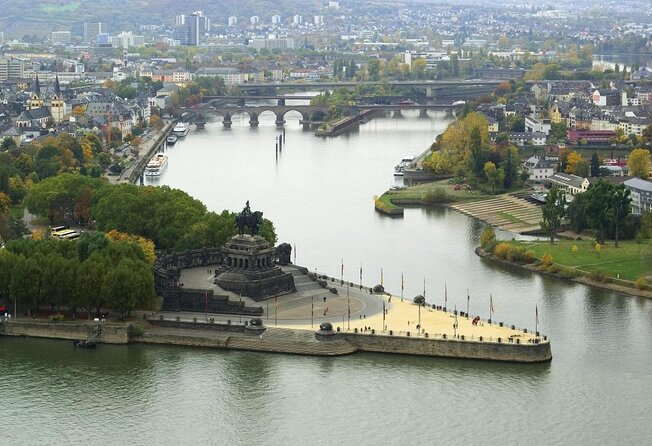
The tour saves its longest stop for Deutsches Eck, the headland where the Rhine and Moselle meet. This is the natural finale. After the compact squares and churches of the Old Town, the riverside setting gives you more room and a much broader view.
The main feature is the Kaiser Wilhelm memorial. Kaiser Wilhelm I, the first German Emperor, is represented by the monument erected in 1897. It is a large, formal marker of imperial Germany, and its setting at the confluence gives the final stop a strong sense of place.
You have about 35 minutes here, more than twice the time allotted to the earlier stops. That lets the guide explain the memorial and point out additional sights around the end of the route. It also gives you time for photographs without having to rush immediately to the next church or square.
There is a useful balance in ending here. Münzplatz introduces Koblenz as a Roman foundation, while Deutsches Eck presents the city as a site of later German national memory. The two ends of the walk show how different eras claimed the same strategic meeting point of rivers.
The tour ends at Konrad-Adenauer-Ufer, rather than returning to Münzplatz. That is convenient if you plan to continue along the waterfront, spend more time at Deutsches Eck, or simply want to finish near one of Koblenz’s best-known sights. If you need to return to your starting point, remember to allow extra time after the official end.
What the private format means in practice
This is a private activity for your group alone, with a maximum of 15 people. That changes the feel of the walk. You do not have to keep up with an unrelated crowd, and you can ask questions that match your interests.
A private group is especially useful if your party includes children, older family members, or people who prefer a slower pace. The published timing is still fairly structured, so private does not mean unlimited time at every stop. It does mean the guide’s attention is directed toward your group.
The English-language option is another practical advantage. One rating described the guide’s explanation as lively and easy to understand, which is exactly what you want on a short introductory walk. No guide name is provided, so you should not book expecting a particular individual.
Several daily tour times are available. That matters if you are fitting Koblenz around a train, a river cruise schedule, lunch, or another activity. The tour is also near public transportation, and most people can participate according to the supplied details.
Is $420.53 a fair price?
The cost is $420.53 per group, for up to 15 people. At the maximum group size, that works out to about $28 per person. For a family reunion, club, or larger travel party, that can be reasonable for a private English-language introduction with a clear route and a dedicated guide.
For two people, the same total works out to more than $210 each. That is a very different value calculation. A couple who wants a private guide and prefers a set two-hour overview may still find it worthwhile, but anyone focused mainly on seeing the squares and riverfront should think carefully about the premium.
The tour includes no admission charges at the listed stops. That does not mean every possible church interior or nearby attraction is part of the experience. The value comes from the guide’s explanations, the private format, and the efficient movement between landmarks.
I would book it at this price when the group is large enough to share the cost, when your time in Koblenz is short, or when you want a clear introduction without planning the route yourself. For a small group on a tight budget, a self-guided walk may make more financial sense.
Timing, meeting point, and small planning details
The walk begins at Münzplatz, Münzplatz, 56068 Koblenz. The ending point is Deutsches Eck on Konrad-Adenauer-Ufer, also in 56068 Koblenz. Since the tour does not finish where it starts, think ahead about what you want to do next.
The total duration is about two hours. The scheduled stops add up to 95 minutes, leaving roughly 25 minutes for walking between locations, transitions, and the guide’s movement through the Old Town. That is a comfortable pace for an introductory tour, but it is not designed for long breaks.
You receive confirmation at booking, and the ticket is available on your mobile device. Free cancellation is available if you cancel at least 24 hours before the start time. If you cancel or request changes within 24 hours, the payment is not refunded and changes are not accepted.
The rating is 4.7 from 16 reviews, with 94 percent recommending the experience. The sample size is not large, so I would read those numbers as a positive signal rather than a guarantee. The specific praise for lively, understandable explanations is more useful than the score alone.
Who should book this Koblenz tour?
I think this walk suits you best if Koblenz is new to you and you want the essential Old Town sights in one sitting. It also works well for a larger private group that values convenience and a guide’s help with context.
It is a good match for:
- First-time visitors with only a morning or afternoon in town
- Families and groups who want a private English-language guide
- Cruise passengers looking for a compact shore excursion
- History-minded visitors who want Roman, medieval, French, and imperial connections
- People who prefer a route that ends at Deutsches Eck
You may want something else if you hope to spend a long time inside the churches, visit museums, or explore Koblenz at a slow pace. The two-hour schedule gives you a strong outline, not a full day of detailed sightseeing.
Final verdict: book it for orientation and shared value
I would book this tour for a first look at Koblenz, especially with six or more people sharing the group price. The route is well chosen, the historical range is broad, and the final arrival at Deutsches Eck gives the walk a clear finish.
For a couple, the decision depends on how much you value a private guide. The cost is high for a small party, but the tour saves planning time and gives meaning to sights that can otherwise blur together. If you want a focused introduction, book it. If you prefer to wander and keep costs low, use the route as a self-guided plan and spend your budget elsewhere.
FAQ
How much does the Koblenz Old Town tour cost?
The tour costs $420.53 per group, with up to 15 people included.
How long does the experience last?
The walking tour lasts approximately two hours.
What language is the tour offered in?
The tour is offered in English.
Where does the tour begin?
The meeting point is Münzplatz, Münzpl., 56068 Koblenz, Germany.
Where does the tour end?
The tour ends at Deutsches Eck, Konrad-Adenauer-Ufer, 56068 Koblenz, Germany.
Is this a private tour?
Yes. Only your group participates, and the group can include up to 15 people.
What sights are included?
The route includes Münzplatz, Liebfrauenkirche, the Basilica of St. Castor, Schängelbrunnen, and Deutsches Eck with the Kaiser Wilhelm memorial.
Can I cancel for a full refund?
Yes, if you cancel at least 24 hours before the experience start time. Cancellations or changes made less than 24 hours in advance are not accepted and are not refunded.
Just added around Koblenz
- e-Scavenger hunt Koblenz: Explore the city at your own pace★ 4.0 · 20 reviews
- Koblenz Guided tour of the Ehrenbreitstein Fortress★ 4.5 · 7 reviews
- Koblenz – Old Town with the Ehrenbreitstein Fortress★ 4.0 · 7 reviews
- Koblenz: Private pub crawl with insider guide & free shots★ 5.0 · 5 reviews
- Koblenz: The Living Vineyard, Nature & Wine Enjoyment★ 5.0 · 14 reviews
- Koblenz: Rhine Valley Castle Sightseeing Cruise★ 4.6 · 98 reviews
- Koblenz: Sunset Boat Cruise★ 4.6 · 80 reviews
- Koblenz: Christmas Boat Tour with Mulled Wine★ 4.3 · 35 reviews
Koblenz Tours, compared.



Browse the lists this tour appears in