
Review · COLOGNE TOURS
Roman Cologne: A Self-Guided Audio Tour
Cologne’s Roman past is easy to miss beneath its modern streets. This self-guided walk brings that buried city into focus, from the cathedral and Northern Gate to the Roman harbor road, Praetorium, and the old temple district. I especially like the GPS-triggered storytelling and the fact that you can take the tour over your own schedule.
I also like the price: at $11.99, it costs less than many live walking tours and remains available for future use. You get useful context for landmarks you may otherwise glance at and miss. The main caution is that the tour follows a set route and narrative, so starting somewhere else or walking it backward can be confusing.
Key points to know before you go
- Roman Cologne beneath the modern city: Hear how Roman roads, buildings, temples, and harbor works shaped the city you see today.
- A flexible 60 to 90 minutes: Pause for photos, stop for lunch, or finish the walk another day without a time limit.
- Works through the VoiceMap app: The app uses GPS to trigger each section, so you can keep your phone in your pocket while walking.
- Download before leaving Wi-Fi: Audio, maps, and location data are designed for offline use, but one user had trouble when the tour had not worked properly without internet.
- Major sights and small details: The route covers the cathedral, Roman-Germanic Museum, Praetorium, Great St Martin Church, and less obvious Roman traces.
- English only and self-guided: There is no live guide, group departure, transportation, food, or admission included.
Roman Cologne begins beside the cathedral
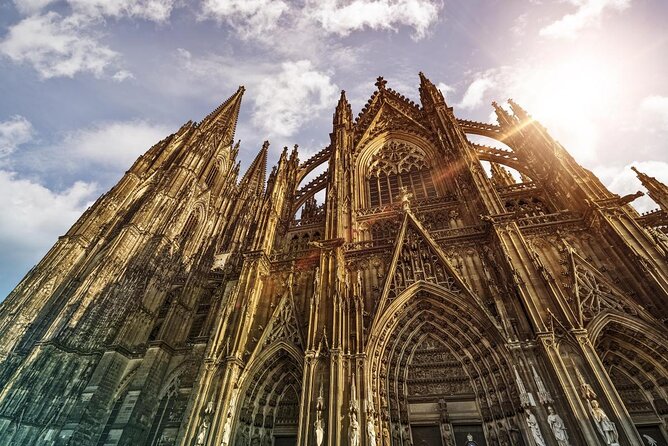
The walk starts in front of the Kreuzblume, beside Cologne Cathedral at Domkloster 4. This is a sensible place to begin because the cathedral gives you an immediate point of reference, even though the main subject is the Roman city beneath and around it.
The cathedral itself is medieval, not Roman, but it provides the first lesson of the tour: Cologne has been rebuilt and reshaped many times. As you walk, the audio helps connect the grand building in front of you with the earlier settlement below the present street level.
You are not entering the cathedral as part of the tour. You pass by it while the narration explains what you are seeing and how the site fits into Cologne’s long sequence of construction. That distinction matters if you hoped for an interior visit. Any cathedral, museum, or other attraction admission is your responsibility.
The route is designed to be followed in order. VoiceMap uses your phone’s location to start audio at the appropriate points. Once you have downloaded the tour and reached the starting place, you can usually put the phone away and listen as you walk. That simple setup is one of the best features here, especially if you dislike staring at a screen in an unfamiliar city.
More self-guided routes in Cologne:
- Cologne: Scavenger Hunt Self-Guided Tour
★ 4.3 · 78 reviews - Cologne Haunted Quest: The Witch Self-Guided Tour
★ 3.0 · 38 reviews - Aachen Scavenger Hunt and Highlights Self Guided Audio Tour
★ 4.0 · 17 reviews
The Northern Gate and Cologne’s Roman entry point
From the cathedral area, the walk passes the remains or location associated with the Romans’ Northern Gate. This stop helps you picture Cologne as a fortified Roman settlement rather than simply a modern German city with scattered old buildings.
The audio is useful here because Roman remains are not always dramatic. You may be looking at fragments, foundations, or a modern street laid over an ancient route. Without explanation, the connection can be hard to read. The narration supplies the missing link and shows you how the defensive edge once related to the city inside.
This is also where the tour’s format works better than a simple list of dates. You are walking between sites, hearing the story at the place where it matters. The route does not require you to stand still for a formal talk, and you can pause the audio if you need time to examine a marker or take photographs.
A Roman mosaic through the museum window
One of the most rewarding stops comes at the Roman-Germanic Museum. The tour does not include museum admission, but you can peer through a window to see one of the world’s largest and best-preserved Roman mosaics.
That arrangement is practical, though it has limits. You get a look at an important object without adding a museum visit to your schedule, but the experience is not the same as seeing the mosaic in a full gallery setting. If the museum is a major reason for your visit, plan to check its opening arrangements separately and treat this walk as an introduction rather than a substitute.
The audio gives the mosaic a place in the larger story of Roman Cologne. That is the useful part. Instead of seeing a beautiful floor as an isolated object, you begin to understand how much Roman material remains in the city and how carefully it has been preserved.
Walking the Roman harbor road at Kurt Hackenberg Platz
The route continues along Die Römische Hafenstraße in Köln, the Roman harbor road. This is one of the tour’s more unusual stops because the road was imperfectly rebuilt in Kurt Hackenberg Platz.
That imperfection is worth explaining. Reconstructed Roman features can look clean and convincing, but they do not always reproduce the ancient arrangement exactly. The tour uses this site to show how modern attempts to represent the past can be incomplete or slightly off. I like that approach because it encourages you to question what you see instead of treating every stone as untouched Roman fabric.
The harbor road also gives the Roman city a practical side. Cologne was not only about monuments and military power. Roads connected working parts of the settlement, including the riverfront and areas where goods moved through the city. You get a stronger sense of daily urban life here than you do from a single grand ruin.
More audio tours in Cologne:
- Cologne skyline tour with audio guide 90 minutes
★ 4.5 · 8 reviews - Private audio book city rally in the Volksgarten in Cologne
★ 3.5 · 6 reviews - Private audio book city rally around Cologne Cathedral and the Old Town
★ 3.5 · 5 reviews - Berlin: Solar Powered Sunset Catamaran Cruise & Audio Guide
★ 4.6 · 1,043 reviews
The Praetorium, Roman power below today’s streets
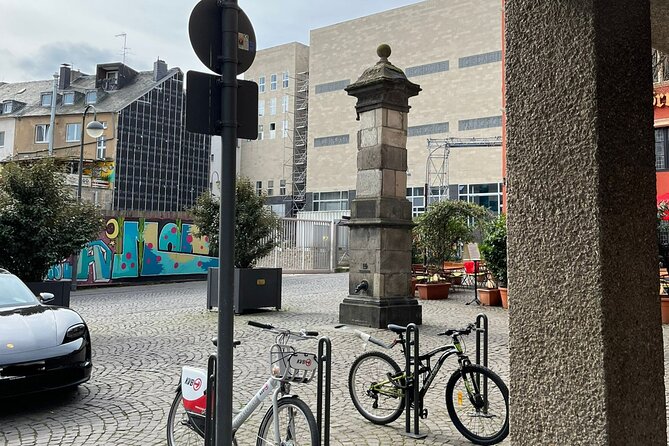
Next comes the Römisches Praetorium, described as the largest Roman palace in the Rhineland. This is one of the central historical stops, and the audio explains why the building mattered within Roman Cologne.
A palace site can be difficult to understand from street level. The modern city does not present the full structure in one easy view, and the remains may feel fragmentary. The narration helps you imagine the scale and importance of the complex without pretending that the entire Roman building is still standing.
This is where the tour’s focus on what lies beneath Cologne pays off. The city is not arranged as a Roman archaeological park. Modern buildings, roads, and public spaces occupy the same ground. The audio gives you a second layer to picture as you move through the present-day streets.
The tour does not include entry fees, so check the site’s current access arrangements if you want more than the exterior experience. The walk itself remains useful even if you do not go inside an attraction.
Alter Markt and Great St Martin Church
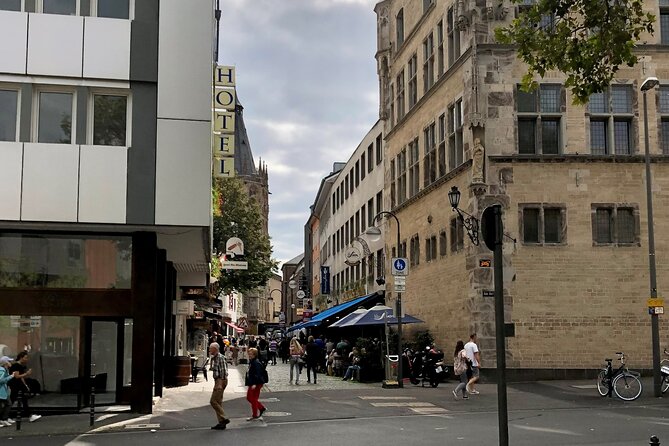
The route passes through Alter Markt, Cologne’s old market. This is a good point to shift from Roman government and infrastructure to the way later city life developed over the same footprint.
The old market is a public space with a long urban role, but the tour keeps bringing you back to the earlier Roman city. You learn to look for continuity rather than a single preserved period. A market square can be medieval in appearance and still occupy ground that had importance centuries before.
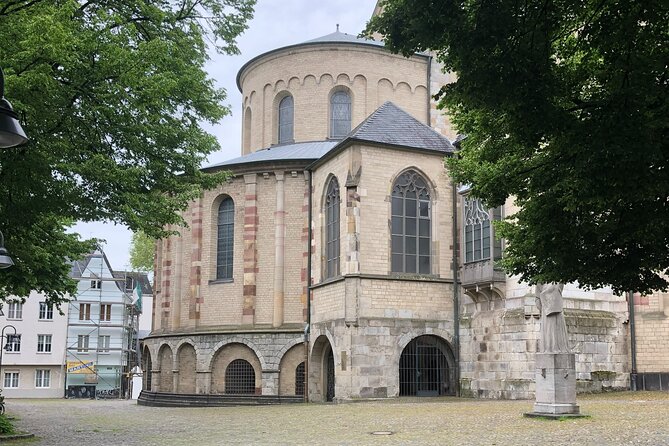
Nearby, the tour passes Great St Martin Church. The church was built in the Middle Ages on the foundations of a Roman warehouse, a detail that neatly sums up Cologne’s layered character. A later religious building reused an earlier practical structure, and the old Roman purpose became part of the foundation for a new city.
I find this kind of stop more helpful than a parade of famous monuments. It shows you how history survives in awkward, ordinary ways. The Roman past is not always a complete wall or a polished museum piece. Sometimes it is the footprint beneath a church.
Schmitz Säule and an unexpected link to the moon landing
At Schmitz Säule, the audio tells you what the 1969 moon landing has to do with the ancient Romans in Cologne. This is the sort of detail that can keep a history walk from becoming a string of names and dates.
The connection is not obvious from the street. That is precisely why the stop works well in an audio format. You can stand near the column, listen to the explanation, and then continue with a story you are unlikely to discover by simply following a standard sightseeing map.
The tour includes several moments like this, where a small object or modern reference opens a larger question about how Cologne remembers its Roman past. If you enjoy local details that connect distant periods, this section should be among the more memorable parts of the walk.
Roman soldiers on the Gürzenich facade
The walk then passes the Gürzenich Köln, an imposing Gothic building. The audio points out how to spot the celebrated Roman soldiers Marsilius and Agrippa on its facade.
This is a classic example of how the tour teaches you to look up and look closely. You might pass a Gothic facade for its architecture alone, but the audio directs your attention to figures connected with Cologne’s Roman identity. The contrast between the medieval building and Roman characters makes the city’s habit of layering history especially clear.
You do not need to be an archaeology specialist to follow the route. The appeal is in having someone point out details that you might otherwise walk past. At the same time, the tour remains dependent on your attention. If you rush from point to point, you may miss the small visual clues the narration describes.
St Maria im Kapitol and the former temple district
The final part of the route passes through the former Roman temple district and reaches St Maria im Kapitol. This is another place where the present building helps reveal the earlier city rather than replacing it.
The church belongs to a later period, while the tour explains the Roman religious area that once occupied this part of Cologne. That change from temple district to Christian church reflects a major shift in the city’s beliefs and institutions. You are not simply looking at one monument. You are following how a place was given new meaning over time.
This stop also reinforces the tour’s main idea: Roman Cologne is not confined to one fenced-off ruin. Its traces are scattered through streets, churches, reconstructed features, museum displays, and building facades. The audio gives those pieces a common thread.
Finishing at the Ubii Monument
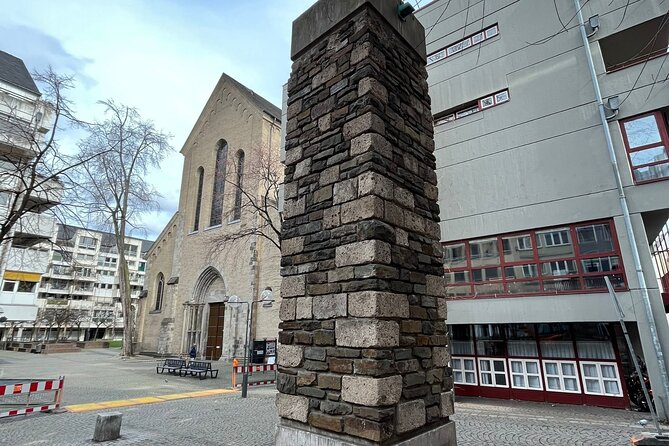
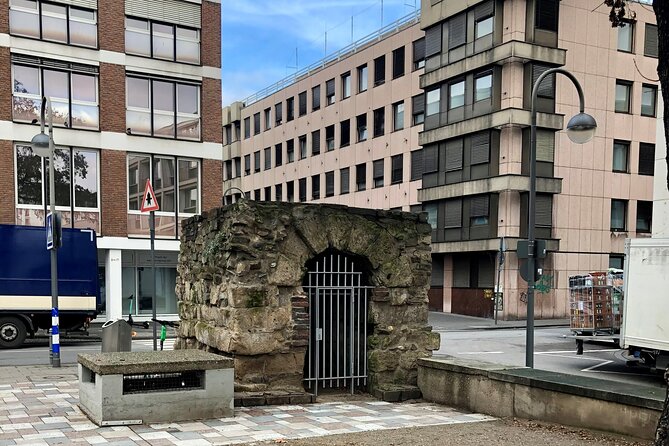
The tour ends near the Ubii Monument at Mühlenbach 35, 50676 Köln. The monument is described as the oldest stone tower in Germany, giving the walk a strong closing point.
Ending at a tower is fitting because the route has moved through several types of Roman evidence: roads, a palace, a warehouse foundation, a temple district, a gate, and public buildings connected with later Cologne. The Ubii Monument leaves you with a clear physical reminder of the earliest part of the story.
The end point is not back at the cathedral, so plan your next move before starting. You are not dependent on a tour group or a scheduled return, but you should know that the walk finishes in a different part of central Cologne.
How the VoiceMap format works in practice
You purchase access and download the VoiceMap app for Android or iOS. The tour includes the audio, map, and geodata for offline use, and access does not expire. That means you can pause the experience and return to it later rather than racing to finish during one short booking window.
Download everything before you set out. The tour is intended to work without mobile data or international roaming, but one user found that it did not work without internet access. The provider’s instructions say the files should be stored on your device, so the safest approach is to download the route on reliable Wi-Fi and test it before leaving.
GPS-triggered audio is convenient, but it also explains why the route is not ideal in reverse. The narration follows a storyline, and the app is built to activate sections based on your location. If you begin somewhere other than the dedicated start, you may find yourself trying to follow instructions backward.
You can stop, start, and skip a location in the app. You can also keep the phone in your pocket once the route is running. Headphones are not supplied, and you need your own smartphone and headphones if you want private listening.
Is $11.99 good value?
At $11.99 per person, this is a modest-cost way to add structure to a walk through central Cologne. You are paying for the narration, route design, map, and lasting access, not for a live guide or entrance to a monument.
I see the strongest value in the context. The cathedral, old market, Gothic churches, and city streets are free to view, but understanding their connection to Roman Cologne is harder without help. This tour turns a normal city walk into a focused history route.
The price is less attractive if you want a live conversation, personal recommendations, or detailed help with questions along the way. It also does not cover museum or attraction tickets, transportation, food, or drinks. For a self-guided audio walk, though, the cost is fair, especially since you can use it without a time limit.
The overall rating is 3.9 from 15 ratings, which fits the experience’s strengths and weaknesses. The most positive points are the easy pace, the surprising details, the useful historical context, and the pleasant voice. One person living in Cologne for nearly 30 years still learned new things, including details connected with Höherstraße and the Gürzenich. That tells you the route is not limited to the standard postcard view.
Who should choose this Roman Cologne walk?
I would choose it for an independent visitor who wants a clear theme rather than a general introduction to Cologne. It suits you especially well if you enjoy archaeology, city layers, Roman history, or finding meaning in buildings that are not obvious attractions.
It also works for a day when museums and other sights are closed. The walk can be taken on any day during the stated operating period, and one person used it successfully on New Year’s Day when many other activities were unavailable.
Families and small private groups may appreciate the freedom to pause without holding up strangers. People who prefer a live guide should look elsewhere, since this is a recorded experience with no group leader. The English-only format also makes it less suitable if you need another language.
Give yourself closer to 90 minutes if you want to stop, look closely, and take photographs. The walk can be completed in about an hour, but the route loses some of its value if you hurry through the sites.
Should you book it?
Book this tour if you want an affordable, flexible way to understand Cologne’s Roman foundations and you are comfortable using a smartphone app. The best parts are the unexpected connections, the view of the Roman mosaic, the reconstructed harbor road, and the way later buildings reveal earlier uses.
Skip it if you want a live conversation, a fully guided interior tour, or a route you can easily walk backward. Start at the dedicated point near the Kreuzblume, download the complete tour in advance, and treat the narration as a guide to details you might otherwise miss. For the right kind of visitor, it turns an ordinary central Cologne walk into a focused look at the city beneath the city.
FAQ
How long does the Roman Cologne audio tour take?
The tour takes approximately one hour to one hour and 30 minutes, depending on your pace and how often you stop.
Where does the tour start?
It starts in front of the Kreuzblume near Cologne Cathedral. The listed meeting address is Domkloster 4, 50667 Köln, Germany.
Where does the tour end?
The route ends near the Ubii Monument at Mühlenbach 35, 50676 Köln, Germany.
Is the tour available offline?
Yes. The audio, map, and geodata can be downloaded to the VoiceMap app for offline use. Download the complete tour before setting out.
What language is available?
The tour is offered in English.
Are museum tickets or headphones included?
No. Museum and attraction admission, a smartphone, headphones, food, drinks, and transportation are not included.
Just added around Cologne
- The Legendary Kölsch Brewery Tour★ 5.0 · 282 reviews
- XXL tour (11km)★ 5.0 · 3 reviews
- Street Art Tour Cologne Ehrenfeld★ 5.0 · 64 reviews
- City Tour per Rikscha in Cologne★ 5.0 · 26 reviews
- Hard Rock Cafe Cologne With Set Lunch or Dinner★ 4.0 · 45 reviews
- Cologne City Tour “Domstadt Experience” Exclusive tour for up to 12 people★ 5.0 · 6 reviews
- Street Art Tour Köln Ehrenfeld★ 5.0 · 33 reviews
- Scavenger hunt Belgian Quarter Cologne★ 5.0 · 8 reviews
Cologne Tours, compared.


Virtual Reality Time Travel Experience Ticket
Read our review →
The Night Watchman Old Town Walking Tour in German
Read our review →Browse the lists this tour appears in