
Review · COLOGNE TOURS
Aachen – Old town Guided tour
Aachen’s Old Town packs a surprising amount of history into a small area, and this private 90-minute walk gives you a quick route through its major sights. The focus is Charlemagne, medieval Aachen, and the city’s surviving Gothic buildings, with a guide handling the map work as you move from the cathedral to Ponttor.
I like the small private format, which lets only your group participate, and I like the clear run of historic stops: the cathedral, Puppenbrunnen, Elisenbrunnen, Grashaus, City Hall, Haus Löwenstein, and Ponttor. The main consideration is price: at $406.51 for up to 15 people, it can be sensible for a full group, but expensive for one or two people. Entrance fees are also not included.
Key points at a glance
- Aachen Cathedral begins the tour: See one of Europe’s oldest cathedrals and learn about its link to Charlemagne.
- The Puppenbrunnen adds a playful stop: Bronze figures move at this fountain, with symbols tied to Aachen’s trades, people, and past.
- Elisenbrunnen reveals the spa city: Its two fountains contain sulfurous thermal water associated with Aachen’s healing springs.
- Medieval buildings fill the central route: Grashaus, Haus Löwenstein, and City Hall show how Aachen developed as an important imperial city.
- Ponttor gives the walk a strong finish: This surviving city gate recalls Aachen’s medieval defensive walls.
- The group price rewards numbers: A group of 10 to 15 pays far less per person than a couple booking alone.
Why this short Aachen walk works
Aachen is easy to underestimate. It is not simply a cathedral town with a few old façades. Its center brings together Roman Catholic power, Charlemagne’s imperial story, medieval trade, thermal springs, and the remains of a fortified city.
You can walk between the main sights yourself, but the connections are not always obvious. A fountain may look decorative until someone explains its symbols. A plain old house may seem less important than a grand church until you learn that it served as Aachen’s first town hall. This is where a guide earns the fee.
The route lasts about 1 hour and 30 minutes. That makes it a good fit if you have limited time in Aachen, need a basic orientation, or want the main historic sights explained without committing to a longer museum visit.
The private setup is useful for families, couples, and groups with different interests. You are not tied to a large party, and the guide can keep the walk focused on your group. The supplied booking information does not give a guide’s name, so you should not expect to select a particular guide in advance.
More Old Town Walking Tours in Cologne
- Cologne: The Night Watchman Old Town Walking Tour in German
★ 4.6 · 1,395 reviews - Cologne: Old Town Highlights Walking Tour
★ 4.6 · 1,093 reviews - Cologne Cathedral and Old Town Tour with 1 Kölsch
★ 4.8 · 674 reviews
Meeting at Aachen Cathedral
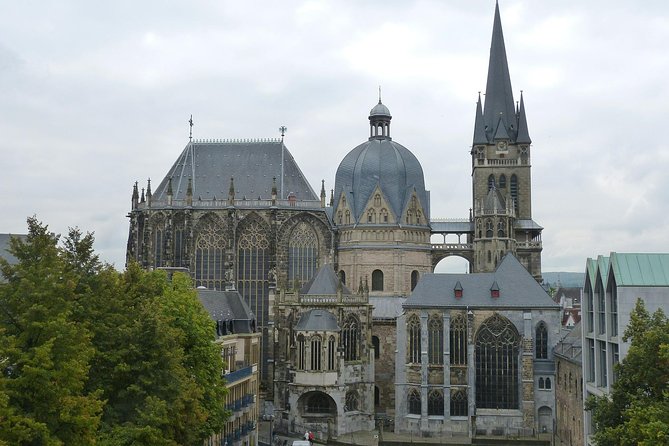
The meeting point is at the Dominformation, Johannes-Paul-II.-Straße 1, 52062 Aachen. That places you beside Aachen Cathedral, an excellent starting point because the church gives the whole walk its historical weight.
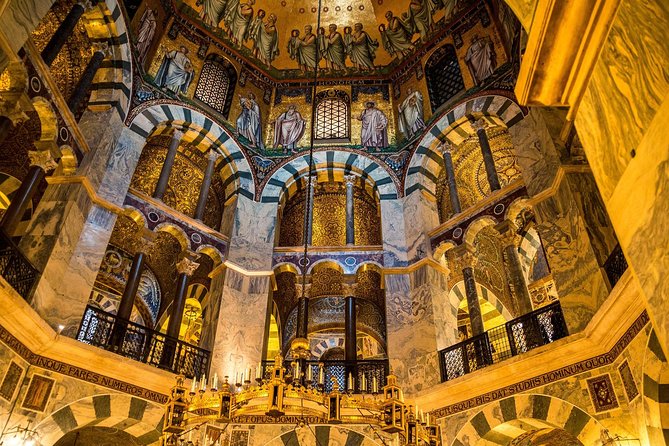
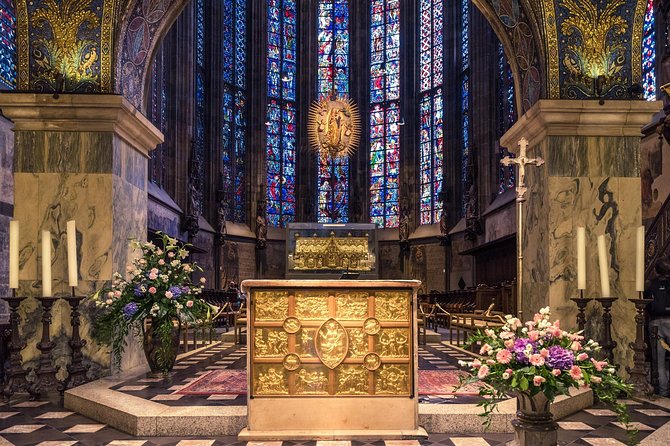
Aachen Cathedral is also known as the Cathedral of Aix-la-Chapelle. It is a Roman Catholic church and the seat of the Diocese of Aachen. Most important for the city’s story, it is one of the oldest cathedrals in Europe and is closely tied to Charlemagne.
You are scheduled to spend about 10 minutes here. That is enough for an introduction and exterior context, but it is not a full cathedral visit. The tour information says you will have the chance to visit the Treasury, yet entrance fees are not included. Ask your guide how the Treasury fits into the walk before assuming that a full visit is covered.
The Treasury contains major medieval church works, including the Cross of Lothair, the Persephone sarcophagus, and the Bust of Charlemagne. Those objects can add much to your understanding of Aachen, but a short guided walk cannot give them the same attention as a dedicated museum visit.
If the cathedral interior or Treasury is your main reason for coming, check the admission arrangements at the start. If your goal is a fast overview of the Old Town, the cathedral stop works well as an opening chapter.
Puppenbrunnen and Aachen’s moving symbols
After the cathedral, you reach the Puppenbrunnen, or Dolls Fountain. Created by Bonifatius Stirnberg in 1975, this bronze fountain uses movable figures to tell a story about Aachen and its people.
The fountain is especially effective because it gives you something to watch while the guide explains the meaning. Its figures include pairs linked with Aachen’s textile industry, trading market, church, education, culture, and social life. A horse and rider, a bishop and church, a market woman, a professor and harlequin, and other figures turn local history into a quick visual lesson.
A clock sits at the top, symbolizing the French occupation. That detail is easy to miss without an explanation. The moving bronze marionettes also make this one of the better stops for children, who may find the fountain more memorable than a long account of medieval politics.
You spend about 10 minutes here. That is enough to look closely and hear the main story, though you will not get an extended art discussion. I see this as one of the route’s best choices because it breaks up the stone-heavy architecture with something lively and easy to understand.
Elisenbrunnen and Aachen’s sulfur springs
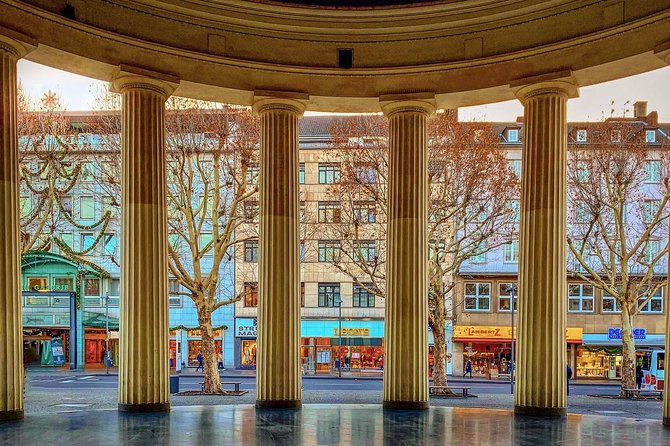
The next 10-minute stop is Elisenbrunnen, a neoclassical fountain associated with Aachen’s thermal water. Two drinking fountains provide access to water with a high sulfur content, and the springs are said to have medicinal properties.
The sulfur smell may surprise you. It is part of the point. Aachen’s importance was not built only on emperors and church ceremonies. Its hot springs helped make the city a place of healing and leisure as well as a center of power.
The visit is brief, so treat it as an introduction rather than a spa experience. You can see the fountain and learn about the thermal water, but the tour does not include a bathing session or a health treatment. The information provided also does not say that drinking the water is required, so follow your own comfort level.
This stop gives the walk some variety. After the cathedral and fountain sculpture, the springs show another reason Aachen mattered. I like that the route does not reduce the city to Charlemagne alone.
More old town walks in Cologne:
- Cologne: Old Town Beer History Tour
★ 4.7 · 659 reviews - Cologne: Old Town Virtual Reality Walking Tour
★ 4.7 · 208 reviews - Cologne: 3 Old Town Breweries Guided Walking Tour
★ 4.8 · 120 reviews - Cologne: Old Town Walking Tour with 1 Brewery Visit & 1 Beer
★ 4.7 · 87 reviews
Grashaus and the first town hall
The route then moves toward the Fish Market and the Grashaus, one of Aachen’s oldest houses. Its construction was completed in 1267, though the site reaches further back in time.
The Grashaus served as Aachen’s first town hall. It was also connected with a medieval village and a prison. That mix of civic business and confinement gives the building a more complicated story than its age alone suggests.
You are not given a separate timed stop here, so this part depends on the walking pace and the guide’s explanation. Take a moment to look at the building rather than treating it as a quick pass-by. Its value is historical context: Aachen’s political life once operated from buildings much smaller and less formal than the later City Hall.
This is also a good example of why a guide helps. Without context, an old building near the cathedral can blend into the surrounding streets. With the story of the first town hall and medieval prison, it becomes a clear part of the city’s development.
Haus Löwenstein and the mystery of its purpose
Across from the town hall is Haus Löwenstein, built around 1344. It is one of the few Gothic buildings to survive the great fire of 1656.
The building’s original purpose remains unknown. That uncertainty is a useful reminder that history does not always provide a neat answer. You will hear about a structure that survived a major disaster, yet still carries a question about why it was built in the first place.
Haus Löwenstein is a short exterior viewing stop, not a major interior visit. Its appeal comes from survival and setting. It stands parallel to the town hall, so you can compare two medieval buildings while the guide explains how fire and rebuilding changed Aachen.
I enjoy this kind of stop because it avoids a parade of only famous monuments. A city is also made of buildings whose owners, uses, and stories have partly disappeared.
Aachen City Hall and the Granus Tower
The City Hall is the route’s grandest civic building. Its Gothic construction began under Gerhard Chorus in the 14th century and was completed in 1349. It was built to host the traditional coronation feast for the Holy Roman Empire and later served as an administrative center.
That connection to imperial ceremony gives the building more force than its official function suggests. Aachen was not merely a local government town. It played a major role in the public rituals surrounding the Holy Roman Empire.
Look for the Granus Tower, a 20-meter-high section that was also used to store weapons. The tower adds a practical military note to a building associated with feasts and ceremony. Medieval civic power needed both display and defense.
The scheduled time here is about 10 minutes. Admission is not included, and the information provided does not promise an interior visit. Plan on admiring the Gothic exterior unless your guide confirms otherwise.
For me, this is the point where the route’s earlier stories come together. The cathedral represents religious authority, the Grashaus early civic life, and City Hall the later ceremonial and administrative role of Aachen.
Finishing at Ponttor
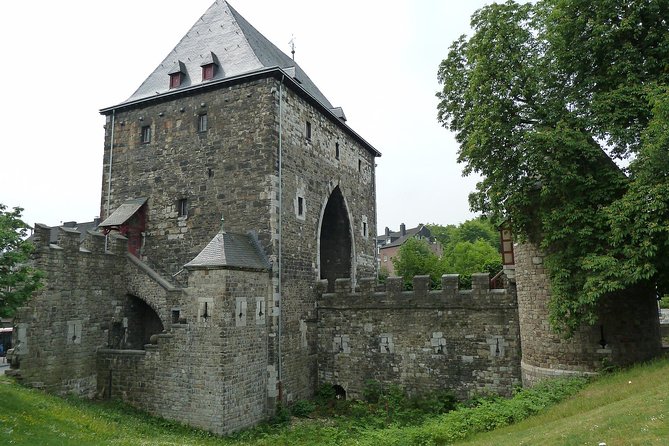
The walk ends at Ponttor, one of the remaining gates from Aachen’s 14th-century city wall. The gate was once known as the Brückenpforte. The itinerary also refers to Marschiertor as one of the surviving gates, but the tour finishes at Ponttor.
You spend about 10 minutes here. Ponttor is a fitting ending because it shifts the focus from city institutions to defense and movement. Medieval Aachen had to control entry through its walls, and gates such as this one connected the protected center with the roads beyond it.
The gate is now used by the German Scout Club and German Scout Association Saint George. That modern use gives the old structure an active purpose rather than leaving it as a frozen monument.
The activity ends back at the meeting point according to the booking details, even though the listed route finishes at Ponttor. Confirm the exact end-of-walk arrangement with your guide, especially if you need to catch transport immediately afterward.
What the private format means for value
The price is $406.51 per group of up to 15 people. That is the key figure to judge carefully.
For a group of 10, the cost works out to about $40.65 per person. At the full 15-person limit, it is about $27.10 each. For a couple, however, it is more than $203 per person, before any entrance fee. The same private price can therefore feel fair to a reunion group and hard to justify for two people.
The cost covers an official tour guide. Entrance fees are not included, so budget separately if you want to enter the Cathedral Treasury or any other paid site. The itinerary lists free admission for several outdoor stops, including the cathedral stop, Puppenbrunnen, Elisenbrunnen, and Ponttor, but that does not remove the need to check fees for interior visits.
I would book this for a group that values a private guide and wants a tight introduction to Aachen. I would think twice if you are alone or traveling as a couple and are comfortable reading a map and using your own guidebook.
The average booking lead time is 39 days. That does not guarantee that every date sells out, but it suggests you should reserve ahead if your schedule is fixed. Confirmation is provided at booking.
Who will get the most from this walk
This tour suits you if you have only a short window in Aachen and want the central sights placed in order. It also fits first-time visitors who prefer stories and explanations to a self-guided route.
Families may like the Puppenbrunnen, since the moving bronze figures offer a welcome change from formal architecture. History fans will get the most from the Charlemagne, Holy Roman Empire, medieval civic, and city-wall connections.
The tour is also a sensible choice for a private group with mixed interests. You can see religious, civic, artistic, and defensive landmarks in one compact outing.
It is less suitable if you want long interior visits, detailed art analysis, or a slow photography walk. The 90-minute format gives you breadth rather than extended time at any one site. The stated information says most people can participate and that the route is near public transportation, but it does not provide detailed accessibility information for every street or building.
The experience has a rating of 3.5 from four reviews, so I would keep expectations measured. The strongest praise centers on the way the guide connects Aachen’s sights with Charlemagne and the city’s important past. That is the tour’s clearest purpose, and it is where the experience should be judged.
Practical details before you reserve
The tour is operated by BlackBuck Travels. It is private, so only your group participates. The meeting point is the Dominformation beside Aachen Cathedral, and the activity is listed as ending back at the meeting point.
Wear comfortable shoes for the Old Town walk. The route includes several stops and connecting streets, even though the total duration is short. Keep your schedule flexible enough to allow for the full 1 hour and 30 minutes.
Because the experience is non-refundable and cannot be changed for any reason, check your date, group size, and meeting point before paying. If you are considering the Cathedral Treasury, ask about its admission and timing before the walk begins.
Aachen’s Old Town is compact enough to explore independently, but the guide’s historical thread is the real product here. You are paying less for distance covered than for the explanation of why each place matters.
Should you book the Aachen Old Town tour?
Book it if you are part of a medium or large group, have limited time, and want a private guide to connect Aachen Cathedral, Charlemagne, thermal springs, medieval civic buildings, and Ponttor in one short walk.
For one or two people, the price is the sticking point. You can still get value if personalized guiding matters greatly to you, but the cost per person is high, and entrance fees come separately.
My call: a practical group tour with a strong historical focus, especially for first-time visitors and families. Before reserving, decide if you want a fast Old Town overview or a deeper cathedral and museum visit. This experience is best at the first task.
FAQ
Where does the Aachen Old Town tour begin?
It begins at Dominformation, Johannes-Paul-II.-Straße 1, 52062 Aachen, Germany, beside Aachen Cathedral.
How long does the tour last?
The tour lasts approximately 1 hour and 30 minutes.
Is this a private tour?
Yes. Only your group participates, and the booking allows up to 15 people.
What sights are included?
The route includes Aachen Cathedral, Puppenbrunnen, Elisenbrunnen, Grashaus, Haus Löwenstein, Aachen City Hall, and Ponttor.
Are entrance fees included?
No. Entrance fees are not included. The outdoor stops are listed with free admission, but paid entries such as the Cathedral Treasury should be checked separately.
Does the tour return to the meeting point?
The activity details say that it ends back at the meeting point. The route itself finishes at Ponttor, so confirm the exact end arrangement with your guide.
Can I cancel or change the booking?
No. The experience is non-refundable and cannot be changed for any reason.
Just added around Cologne
- The Legendary Kölsch Brewery Tour★ 5.0 · 282 reviews
- XXL tour (11km)★ 5.0 · 3 reviews
- Street Art Tour Cologne Ehrenfeld★ 5.0 · 64 reviews
- City Tour per Rikscha in Cologne★ 5.0 · 26 reviews
- Hard Rock Cafe Cologne With Set Lunch or Dinner★ 4.0 · 45 reviews
- Cologne City Tour “Domstadt Experience” Exclusive tour for up to 12 people★ 5.0 · 6 reviews
- Street Art Tour Köln Ehrenfeld★ 5.0 · 33 reviews
- Roman Cologne: A Self-Guided Audio Tour★ 4.0 · 15 reviews
Cologne Tours, compared.


Virtual Reality Time Travel Experience Ticket
Read our review →
The Night Watchman Old Town Walking Tour in German
Read our review →Browse the lists this tour appears in