
Review · KOBLENZ TOURS
Koblenz: Old Town Tour with the Ehrenbreitstein Fortress
The best part of this tour is the pairing of Ehrenbreitstein Fortress with Koblenz’s compact old town. You get the big Rhine Valley view first, then walk through the streets and squares where Roman, French, German, and church history meet. I especially like the private format and the guide’s attention to both major sights and quirky details.
The three-hour plan also works well for a cruise stop or a short stay. The main consideration is price: $430 per group can be good value for a larger party, but it is a serious outlay for one or two people, and the fortress entrance fee is extra.
Key points to know before booking
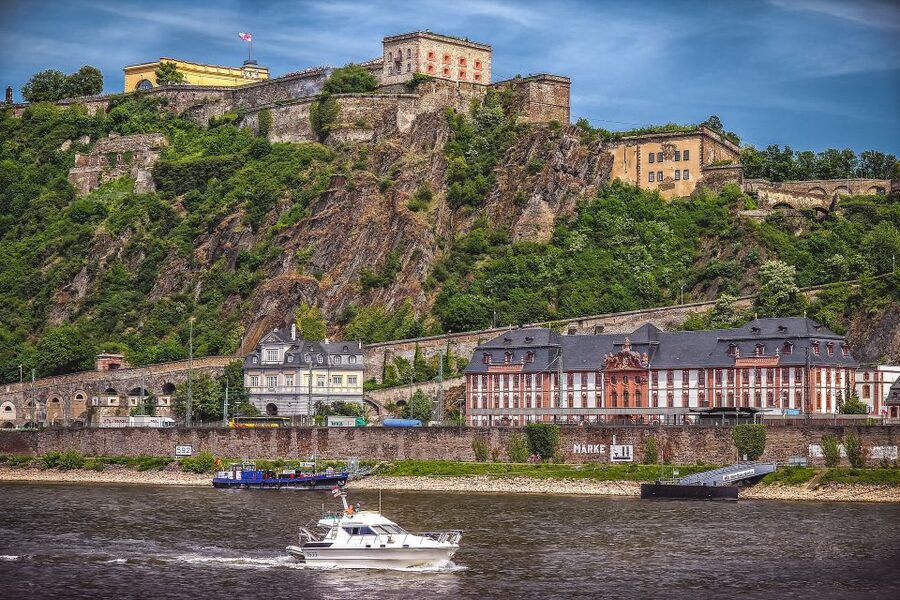
- Ehrenbreitstein rises 118 meters above the Rhine, giving the tour its strongest viewpoint and historical setting.
- The private guide stays with your group, so the pace and explanations can be more personal than on a large group walk.
- Koblenz’s Roman beginnings appear at Münzplatz, where the ancient settlement Castellum apud confluentes gave the city its name.
- The old town route links two important churches, Liebfrauenkirche and the Basilica of St. Castor.
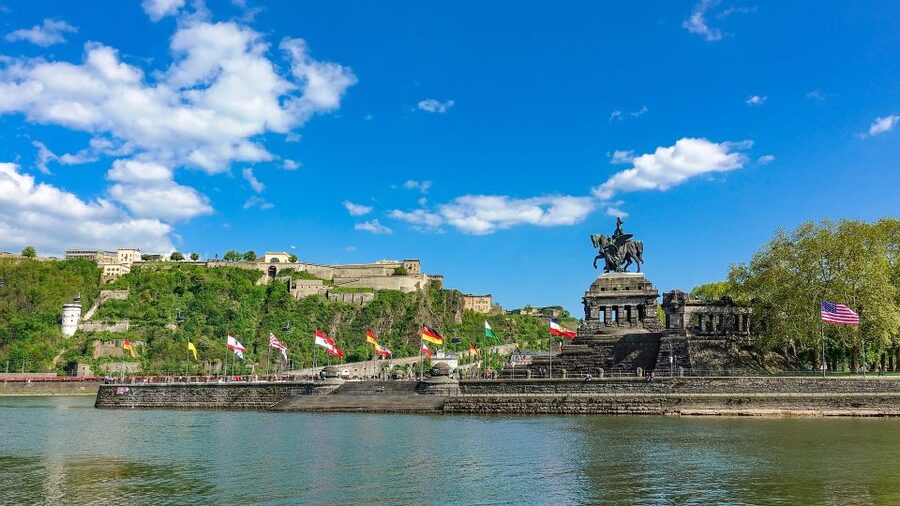
- Deutsches Eck closes the sightseeing loop, with the Kaiser Wilhelm memorial at the meeting point of the Rhine and Moselle.
- The fortress admission is not included, so add that cost when comparing the total price.
Why the fortress gives this tour its shape
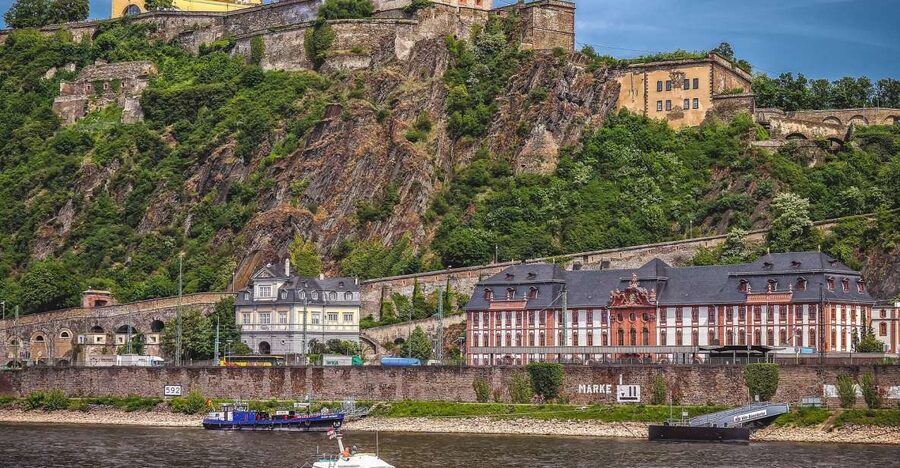
Ehrenbreitstein is not simply a stop for a quick photograph. It is the opening chapter of the tour, and its position above the Rhine helps you understand why Koblenz mattered to rulers and armies for centuries.
The fortress sits 118 meters above the river and was built between 1817 and 1828 as part of a defensive system for the Middle Rhine. It is described as the second-largest fortress complex in Europe, a scale that gives the visit more weight than a standard city viewpoint.
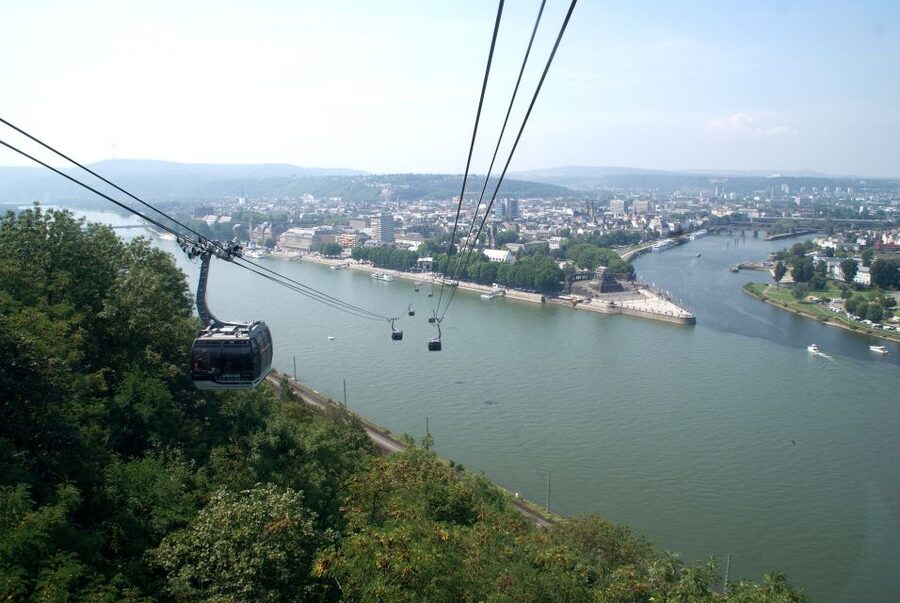
From the height, you can look across the Rhine Valley before heading into the city below. That order is useful. You first see Koblenz as a strategic river junction, then walk through the places shaped by that position.
The site also has a dramatic past. French troops destroyed the fortress in 1801, and its ruined walls later inspired the British poet Lord Byron. His poem focused on the contrast between a fortress that survived years of attack and the peaceful forces that later left its roofs open to the summer rain.
That story gives the stonework a human edge. You are not just looking at walls and ramparts. You are seeing a place that changed from military shield to public monument.
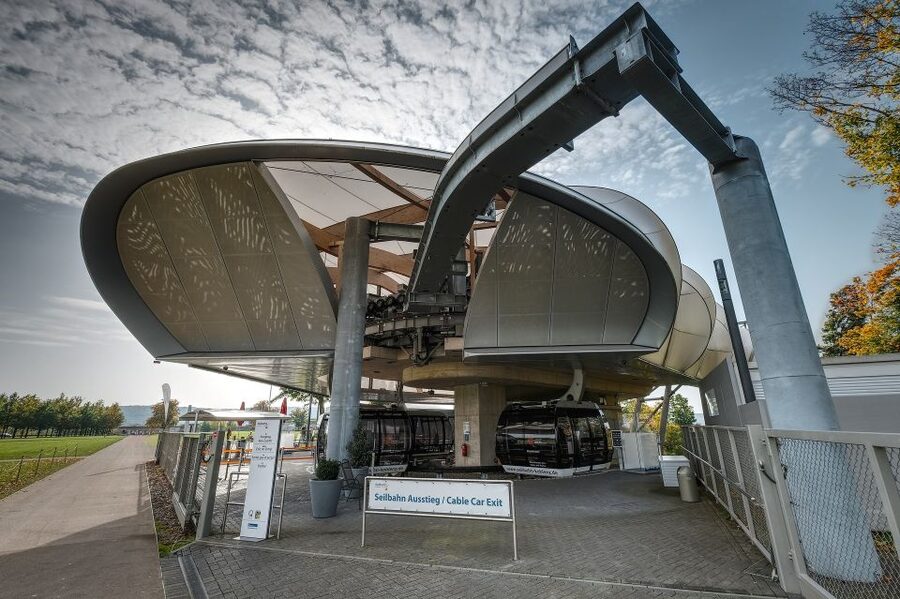
A cable car connects the fortress with Koblenz, and the meeting point is listed at the cable car station on the Koblenz side. Since the activity details also allow pickup at a cruise docking location or a centrally located hotel, confirm the exact starting arrangement when you book. The stated meeting point and pickup option are slightly different, and it is better to settle that before your tour day.
The fortress admission fee is separate. That matters because the advertised $430 covers the private guide and tour arrangement, not every cost connected with the site.
More old town walks in Koblenz:
- Koblenz: Old Town Sightseeing Cruise along the Rhine
★ 4.5 · 305 reviews - Koblenz – Old Town including the Deutsches Eck
★ 4.5 · 16 reviews - Koblenz – Old Town with the Ehrenbreitstein Fortress
★ 4.0 · 7 reviews
From Münzplatz to Koblenz’s Roman roots
After the fortress, the tour moves into the old town and reaches Münzplatz. This square carries a name linked to the electoral coins minted here in the 11th century.
Münzplatz is also tied to Koblenz’s earliest known urban identity. The Romans founded a fort here called Castellum apud confluentes, meaning the fort at the confluence. That name points to the city’s position near the meeting of the Rhine and Moselle, and it eventually helped produce the name Koblenz.
The square has a modern marker of its own. A fountain created by Wili Heinzen was given to the city by Sparkasse Koblenz for Koblenz’s 2,000-year anniversary in 1992. This mix of Roman origins, medieval money, and a modern civic gift is typical of the tour’s approach.
You are not being shown only the postcard sights. The guide connects a square’s name, its older purpose, and the object you see there now. That kind of explanation is one of the strongest reasons to choose a private walk.
A private group also gives you room to ask why a place matters instead of simply collecting names. The available tour languages are English, German, and Italian, and the guide is exclusively with your group.
The church route between two Koblenz landmarks
From Münzplatz, the walk follows a romantic street between two churches. The first is Liebfrauenkirche, recognizable by its onion-shaped domes and its position on the highest point of the city.
The church dates to the 17th century, served as one of Koblenz’s main parish churches during the French Revolution, and was destroyed in 1944. It was rebuilt in 1955, so what you see today is part of a longer story of destruction and repair.
That distinction is worth noting. The church is not an untouched medieval survivor. Its importance comes from the role it played in the city, the damage it suffered, and the decision to rebuild it.
The Basilica of St. Castor is older. The Archbishop of Trier built it between 817 and 836 with support from Emperor Louis the Pious. It began as a Carolingian proprietary church and is identified as the oldest church in Koblenz.
The two churches make a useful comparison. Liebfrauenkirche shows a later baroque character and postwar rebuilding, while St. Castor takes you much closer to the city’s Carolingian period.
You should not expect a long interior-focused church visit unless the guide specifically arranges one. The information provided centers on the buildings, their dates, roles, and appearance as part of the old town walk. The pleasure here is seeing how close major sites are to one another and hearing the connection between them.
Schängelbrunnen and the city’s playful side
The tour also stops at the Schängelbrunnen near Koblenz’s city hall. This fountain is treated as a symbol of the city, and it adds a lighter note after the military and religious history.
The name Schängel comes from Koblenz’s 20-year allegiance to France from 1794 to 1813. In 1940, Carl Burger designed the fountain and dedicated it to the poet Josef Cornelius.
This is the kind of stop that can be missed if you rush only from church to church. A fountain may look like a minor detail, but its name opens a door onto the city’s French connection and local identity.
The supplied tour information also points to quirky attractions along the route. That detail matters because the walk is not limited to solemn monuments. A good guide can use small, unusual features to make the city feel lived-in rather than arranged for sightseeing.
One German description characterizes the experience as active, clearly explained, and tailored to the group. That matches the private setup: you are not locked into a fixed lecture delivered to a crowd. You can use the guide’s time to focus on the subjects that interest your group most.
A few more Koblenz half-days to weigh up
- Koblenz: Rhine Valley Castles and Palaces Boat Tour
★ 4.4 · 1,824 reviews - Koblenz: 2-Hour Sightseeing Cruise on the Rhine
★ 4.6 · 839 reviews - Koblenz: Panoramic Cruise on Moselle River to Winningen
★ 4.4 · 283 reviews - Koblenz: Rhine Valley Castle Sightseeing Cruise
★ 4.6 · 98 reviews
Deutsches Eck and the Kaiser Wilhelm memorial
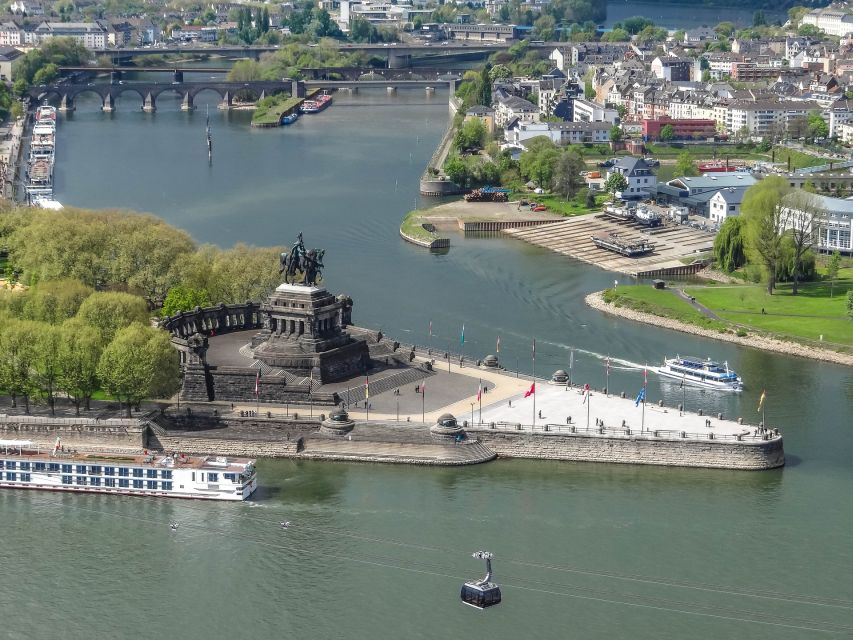
The final major sight is Deutsches Eck, the headland at Koblenz where the Rhine and Moselle meet. It is one of Germany’s most recognizable riverfront locations and a fitting endpoint for a tour built around the confluence.
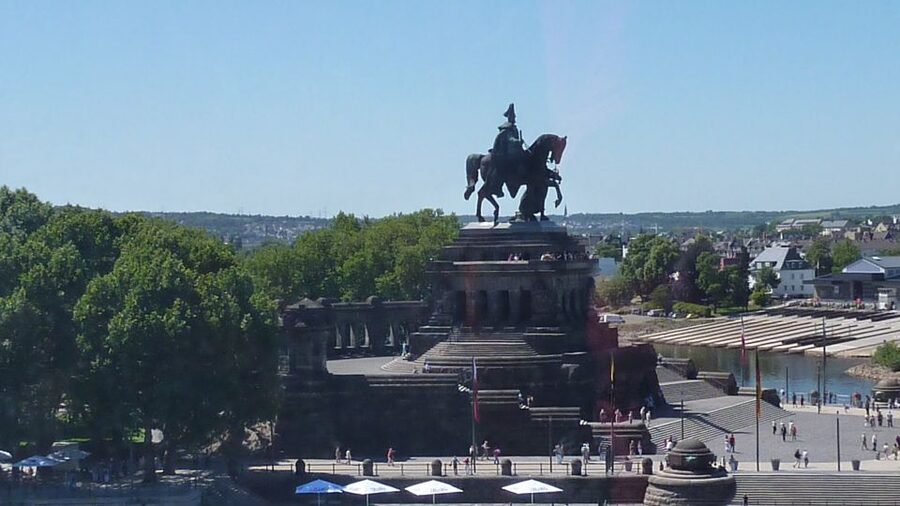
The Kaiser Wilhelm memorial was erected in 1897 for the first German Emperor, Kaiser Wilhelm I. Its location gives the monument a broad public setting, with the two rivers providing the natural frame.
The site brings several themes together. Koblenz’s Roman name came from the confluence, the city grew in importance because of its waterways, and the memorial uses that meeting point to express German political history.
You will want time here to look beyond the statue itself. The river junction is the real geographic key to Koblenz, and the view helps tie the fortress above the Rhine to the old town below.
The tour ends back at the meeting point. Since the supplied details describe the cable car station as both the start and finish, this is convenient if you are continuing independently from central Koblenz. If you are being collected at a hotel or cruise docking location, ask how the return portion is handled before setting other plans.
What the private format is really worth
The price is $430 for a private group of up to 20 people. That is not a budget walking tour, but the calculation changes when you divide the cost across a family, cruise party, or larger group.
For 20 people, the per-person cost is modest. For two people, it is $215 each before the fortress admission, so a small group should think carefully about how much it values a private guide.
The main benefit is control. You have one guide for your group, in one of three listed languages, and the tour can concentrate on what your party wants to understand. The strongest praise attached to this experience centers on clear information, historical places, unusual attractions, and extra details at the fortress.
That is important because the tour covers a lot in three hours. A large group tour may spend less time answering individual questions. Here, the private setting gives you a better chance to ask about the French period, the churches, the fortress, or the city’s Roman name.
The tradeoff is that a private tour is not automatically better for every budget. If you are alone or traveling as a couple, you may prefer a less expensive public walk and visit the fortress separately. If you are traveling with a family or group of friends, the fixed price becomes easier to justify.
The fortress entrance is not included, so compare the full cost rather than the headline figure. The guide fee is the central value here, not a package of admissions or transportation.
Who will enjoy this three-hour route
I would choose this tour if you want a quick but meaningful introduction to Koblenz and prefer context over a simple list of sights. It suits first-time visitors, cruise passengers with limited time, and groups that want one guide rather than several separate visits.
It is also a good fit for people who like military history, church architecture, river cities, and local stories. The route moves from a major fortress to Roman foundations, churches, a civic fountain, and a national memorial, so you get several different sides of Koblenz in one outing.
Families and mixed-age groups may appreciate the variety. The fortress supplies scale and views, the old town provides shorter visual stops, and Schängelbrunnen adds a more playful local detail.
The tour may be less suitable if you want a slow museum visit or long time inside each church. The stated duration is three hours, and the itinerary covers both a fortress and several old-town landmarks. Expect a focused overview, not an exhaustive study of every building.
The activity is wheelchair accessible according to the supplied details. Since the route includes a fortress connected to town by cable car and a city walk, you should still confirm the precise meeting and route arrangements for your own needs.
Timing, language, and practical planning
The tour runs for three hours, with starting times available according to the date you select. That makes it easy to fit into a day in Koblenz, but you should leave breathing room around it if you have a ship departure, train, or timed reservation.
The official guide can conduct the tour in English, German, or Italian. No individual guide name is provided, so you should not expect to request a named guide from the information available.
The starting point is the cable car station on the Koblenz side. Pickup is also offered at a cruise docking location or a centrally located hotel, but the hotel option is limited to central locations. Confirm which arrangement applies to your booking.
Cancellation is flexible up to 24 hours before the start for a full refund. You can also reserve now and pay later, which is useful when your Koblenz plans depend on a cruise schedule or a changing trip itinerary.
There are four published ratings, with an average of 4.8 out of 5. The most useful pattern is not the number alone. The praise focuses on an informative guide, a tour adjusted to the group, historically important places, quirky stops, and extra explanation at the fortress.
Should you book the Koblenz fortress and old town tour?
Book it if your priority is to understand Koblenz quickly, see the Rhine Valley from Ehrenbreitstein, and have a private guide connect the city’s Roman, French, religious, and imperial stories.
The best value comes with a larger party. At $430 for up to 20 people, a family or group can share the cost and gain a focused private experience. A couple should weigh the price against the convenience and personal attention.
Remember to add the fortress entrance fee and confirm your exact pickup point. If those details fit your plans, this is a well-shaped introduction to Koblenz, with enough history to give the sights meaning and enough variety to keep a short tour from feeling like a checklist.
FAQ
How long does the Koblenz tour last?
The tour lasts three hours. Starting times depend on availability for your chosen date.
What languages are available?
The live guide can conduct the tour in English, German, or Italian.
Is the tour private?
Yes. It is a private group experience, with one guide exclusively for your group, and the price covers up to 20 people.
Is admission to Ehrenbreitstein Fortress included?
No. The fortress entrance fee is not included in the tour price.
Where does the tour start and finish?
The listed meeting point is the cable car station on the Koblenz side, and the activity ends back at the meeting point. Pickup is also available at a cruise docking location or a centrally located hotel.
Can I cancel the tour or pay later?
You can cancel up to 24 hours in advance for a full refund. Reserve now and pay later is also available.
Just added around Koblenz
- e-Scavenger hunt Koblenz: Explore the city at your own pace★ 4.0 · 20 reviews
- Koblenz Guided tour of the Ehrenbreitstein Fortress★ 4.5 · 7 reviews
- Koblenz – Old Town with the Ehrenbreitstein Fortress★ 4.0 · 7 reviews
- Koblenz – Old Town including the Deutsches Eck★ 4.5 · 16 reviews
- Koblenz: Private pub crawl with insider guide & free shots★ 5.0 · 5 reviews
- Koblenz: The Living Vineyard, Nature & Wine Enjoyment★ 5.0 · 14 reviews
- Koblenz: Rhine Valley Castle Sightseeing Cruise★ 4.6 · 98 reviews
- Koblenz: Sunset Boat Cruise★ 4.6 · 80 reviews
Koblenz Tours, compared.


Browse the lists this tour appears in