Review · HAMBURG TOURS
Down Town to Speicherstadt, HafenCity and Elbphilharmonie
Hamburg’s story comes into focus on foot, from the merchants gathered at Trostbrücke to the red-brick warehouses of Speicherstadt and the bold curves of the Elbphilharmonie. I love that this walk links old port Hamburg with its newest district in about two hours, rather than treating each sight as a separate postcard stop. I also like the small details, such as the Hygieia Fountain’s message about clean water and the surviving houses of Deichstrasse. The one catch is pace: with eight stops in a short time, you will see the outside of major sights, not tour their interiors.
I like the modest $30.04 price, especially if you want a useful orientation early in a Hamburg visit. The small maximum of 15 people should make it easier to hear the guide, and guide Jutta has been singled out for her humor, stories, and ability to keep the group involved. Plan for open-air walking in any weather, and remember that the tour requires at least eight people to operate.
Key details at a glance
- A port-to-concert-hall route: Begin at Rathausmarkt and finish at the Elbphilharmonie, crossing several distinct chapters of Hamburg’s past.
- Speicherstadt in context: See the world’s largest warehouse district built on wooden piles, rather than simply viewing its famous red-brick walls.
- A compact urban-planning lesson: HafenCity shows how 157 hectares of former industrial land became a new part of central Hamburg.
- Important wartime history: St. Nikolai’s surviving steeple and memorial exhibition add a serious pause to the walk.
- A small-group feel: The maximum is 15 people, with a minimum of eight required for the tour to run.
- A useful ending: The tour finishes at the Elbphilharmonie, where you can visit the platform and look over the port.
From Rathausmarkt into Hamburg’s merchant center
Meet your guide at Rathausmarkt, in front of Hamburg’s grand Town Hall. The 1897 Neo-Renaissance building gives you an immediate sense of the city’s former wealth. Its elaborate facade reflects the power of a trading city that grew through shipping, commerce, and close ties to the port.
You spend about 10 minutes here, enough time to take in the exterior and hear why the building matters. Admission is free, and no separate ticket is needed for any stop on this walk. That keeps the outing simple, but it also means you should expect an exterior-focused tour.
Just behind the Town Hall is the Hygieia Fountain, a small stop with a useful point to make. It represents the importance of fresh water, a reminder that city life depends on practical systems as much as grand buildings. Five minutes may not sound like much, yet this is the sort of detail that helps you notice Hamburg as a working city, not just a collection of handsome facades.
A few more Hamburg half-days to weigh up
- Hamburg: Sex and Crime in St. Pauli Tour for Ages 18+
★ 4.7 · 15,447 reviews - Hamburg: 1.5-Hour Harbor and Speicherstadt Day Cruise
★ 4.6 · 14,200 reviews - Hamburg: 90-Minute Evening Lights Harbor Cruise
★ 4.5 · 7,728 reviews
Trostbrücke and the birth of the port
At Trostbrücke, the tour moves from civic Hamburg to maritime Hamburg. This bridge marks the origin of the city’s port, when sailing ships brought goods into the center and merchants waited to receive them.
The stop lasts about five minutes, so listen closely. The main value is the change in scale it gives you. Hamburg’s port was once tied directly to the city center, while steamships and container vessels later reshaped the waterfront and pushed port activity into a much larger system.
I find this a strong early point in the route because it explains why the next stops look the way they do. The warehouses, canals, commercial houses, and later port projects are not random pieces of architecture. They grew from the practical need to move and store goods.
Deichstrasse and the merchant’s house
Deichstrasse offers one of the clearest looks at Hamburg before modern office blocks and container terminals. Its historic houses date from the 17th century, and they reveal how one merchant’s building could serve several purposes at once.
Goods were stored, business was conducted, and the merchant’s household lived under the same roof. That arrangement helps you picture commerce as part of daily life, not something hidden in a distant industrial zone.
The street survived the fire of 1842 and the destruction of the Second World War, giving it unusual weight in a city that has changed sharply over time. You spend around 10 minutes here. The visit is short, but the street works well as a visual pause between the old port’s origins and the later memorial at St. Nikolai.
St. Nikolai: a serious stop on the route
The Mahnmal St. Nikolai, or St. Nikolai Memorial, changes the mood. Its surviving steeple dates from 1874 and now serves as a memorial to the victims of the Second World War.
Below the ruin is an exhibition about Operation Gomorrha. The tour schedule allows about 10 minutes here, which is enough for an introduction but not a full museum visit. If this part of Hamburg’s wartime story matters to you, make a note to return with more time.
This stop is valuable because it prevents the walk from becoming a simple parade of attractive buildings. Hamburg’s grand commercial success came with severe damage and loss, and the ruined church gives that past a physical form. The guide’s job here is especially important. The first review describes Jutta as funny, well informed, and good at adding unexpected facts and stories, while keeping the group engaged. That mix of lightness and respect is useful on a route that shifts quickly between architecture, trade, and wartime memory.
Same city, a completely different sort of afternoon:
- Hamburg: 2-Hour XXL Port of Hamburg Cruise Tour
★ 4.7 · 6,979 reviews - Hamburg: Line A Sightseeing Hop-On Hop-Off Bus Tour
★ 4.6 · 6,958 reviews - Hamburg: Elbphilharmonie Plaza Guided Tour
★ 4.7 · 5,882 reviews - Hamburg: Hamburg Dungeon Admission Ticket
★ 4.7 · 5,745 reviews
HafenCity and 157 hectares of change
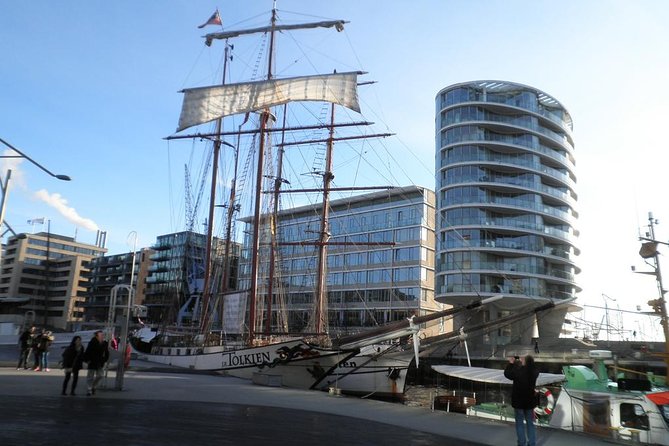
From the older city, you enter HafenCity, one of Europe’s largest city-planning projects. The district transformed 157 hectares of former industrial land into a new urban quarter.
You spend about 10 minutes learning how that change happened. The walk does not provide a full architectural survey, but it gives you a way to read the district. Instead of seeing only new buildings, you can consider the larger question: how does a port city reuse land that once served ships, storage, and industry?
This is one of the tour’s most useful contrasts. Deichstrasse shows a merchant’s home and warehouse from centuries ago. HafenCity shows Hamburg making room for a new phase of city life. The two areas sit close together, yet they represent very different ideas about work, housing, movement, and the waterfront.
The route is also practical for first-time visitors. You do not need to arrange transport between each sight. You walk from the center through the historic port area and onward to the Elbe Philharmonic Hall. Still, wear shoes suited to two hours on foot, and dress for conditions rather than relying on a perfect forecast. The walk operates in all weather.
Speicherstadt’s red brick and wooden foundations
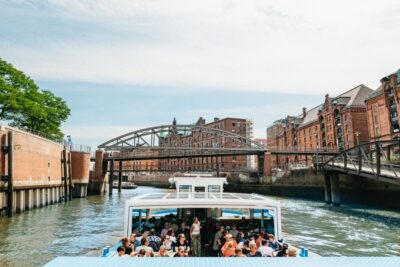
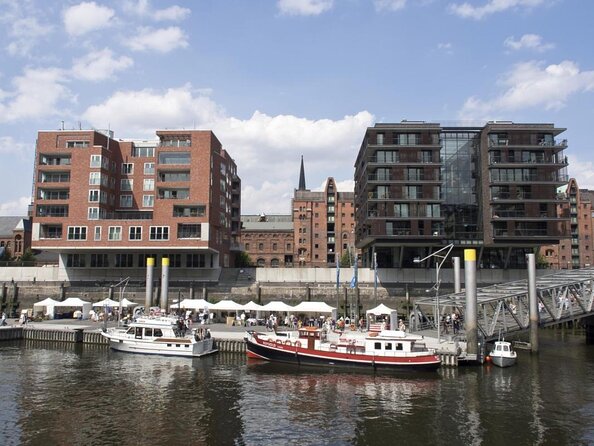
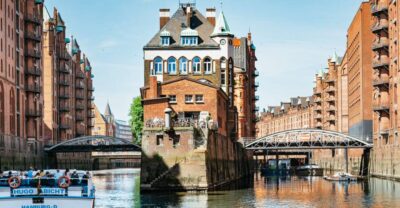
Speicherstadt is the visual centerpiece for many people on this walk. It is the world’s largest red-brick warehouse district built on wooden piles, inaugurated in 1888 and restored after the Second World War.
The district is also part of the UNESCO World Heritage list. That recognition matters, but the guide’s explanation matters more during a short visit. The warehouses were built to handle goods arriving through Hamburg’s port, so the tall brick blocks and waterways reflect a commercial system, not just a decorative style.
You have about 15 minutes here, the longest scheduled stop. Use it to look closely at the brickwork, scale, and relationship between the buildings and canals. Since the tour does not include attraction admission, you will mainly experience Speicherstadt from the outside. That is enough to understand its form, but you will need a separate plan if you want to enter museums or other paid sights in the district.
I appreciate the order of the route. After hearing about Trostbrücke and seeing Deichstrasse, Speicherstadt feels like the next chapter in the story of Hamburg’s trade. The tour turns a famous photo location into part of a wider explanation.
The Elbphilharmonie finale
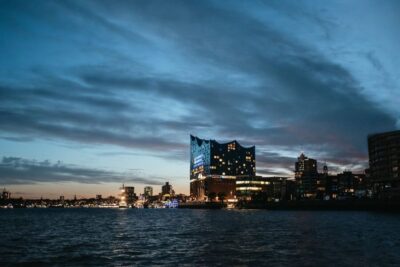
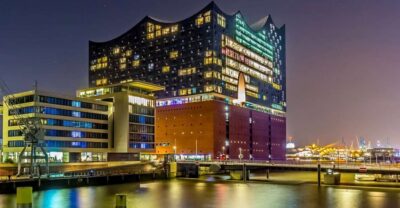
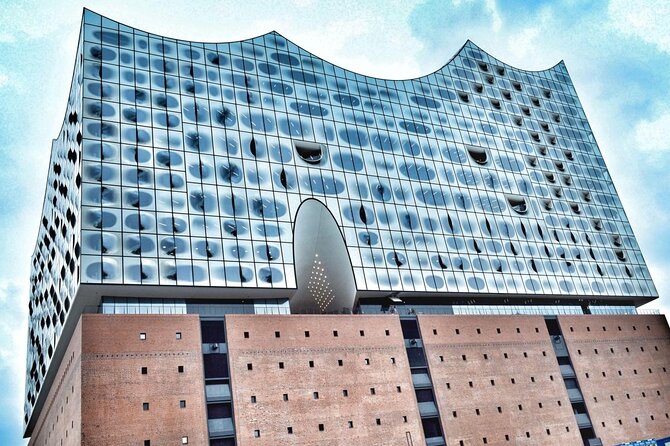
The walk ends in front of the Elbphilharmonie, Hamburg’s most recognizable modern landmark. The concert hall was inaugurated in 2016, with its first concert held on January 11, 2017.
Your guide explains the building’s story and points out its role in Hamburg’s modern identity. The tour does not include a concert or a ticketed interior visit, but the ending gives you a chance to continue on your own. You can visit the platform and enjoy views over the port.
That makes the finish more useful than a simple goodbye. You arrive at a major landmark with enough context to understand why it matters, then have the option to extend your visit. The contrast with Speicherstadt is striking: one is a historic warehouse district on wooden piles, the other a modern concert hall tied to Hamburg’s future-facing image.
The scheduled time here is about 10 minutes. If you want to spend longer at the platform, take photographs, or explore the building, allow extra time after the tour. The exact experience inside is not part of the included walk.
What the $30.04 price gets you
At $30.04 per person, this is priced as a short guided orientation rather than a full sightseeing package. You are paying for a professional English-speaking guide, a carefully arranged route, and the stories that connect eight locations.
The value is strongest if you want structure. In two hours, you move from the Town Hall to the Elbphilharmonie without arranging local transport or working out how the old center connects to Speicherstadt and HafenCity. You also get a compact explanation of Hamburg’s trade, wartime damage, warehouse architecture, and urban planning.
The price is less compelling if you prefer long visits at individual sights. There is no admission included, and each stop is brief. You will not have time for an extended look at the St. Nikolai exhibition, a museum visit in Speicherstadt, or a full exploration of the Elbphilharmonie.
The small group limit helps protect the experience. With no more than 15 people, the guide should be easier to hear than on a large coach-style walk. The minimum of eight is worth noting, since the experience may be canceled if that number is not reached. If that happens, you are offered another date or experience, or a full refund.
Who will get the most from this walk
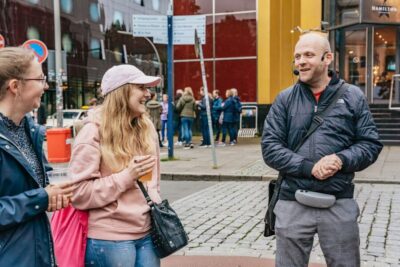
I would choose this tour for a first visit to Hamburg, especially if you want to understand how the city center, port, warehouse district, and new waterfront fit together. It also suits anyone who prefers a guide’s stories to a long list of dates and building names.
The route should work well for most participants, and it is near public transportation. Service animals are allowed. Because it runs outdoors in all weather and lasts about two hours, you should dress for rain, wind, or cold when needed.
This is also a good choice if you have limited time in Hamburg. The walk ends at the Elbphilharmonie, so you can continue sightseeing from there rather than returning to the starting point. The one-way design is efficient, but plan your next activity around the endpoint.
The tour may be less suitable if you need a slow pace, frequent indoor breaks, or extensive time inside museums. The schedule is fairly tight, with stops ranging from five to 15 minutes. You will get a broad, connected view rather than a close study of every building.
Guide style and group atmosphere
A good guide can make this route work, because the subjects change quickly. The walk moves from a city hall facade to clean water, early shipping, merchant homes, wartime destruction, redevelopment, warehouses, and a concert hall.
Jutta is specifically praised for being funny, well informed, and good company. Her approach includes random facts and stories, which can make the history easier to remember. Another assessment describes the guide as professional and able to make the district interesting for everyone.
That tells you what to expect from the best version of this experience: not a dry architecture lecture, but a guided conversation that adds human detail to the streets. The guide’s personality will naturally shape the outing, and no particular guide is guaranteed, so keep that in mind when booking.
The maximum of 15 people is a welcome limit for a walking route with frequent stops. You should still stay close to the guide, especially around busy streets and open public spaces, since the itinerary covers a fair amount of ground.
Booking timing and cancellation terms
The experience is booked an average of 89 days in advance, which suggests that planning early is sensible, particularly if your Hamburg dates are fixed. Confirmation arrives at booking, and the mobile ticket makes the meeting details easy to carry.
You can cancel for a full refund up to 24 hours before the start time. Cancellations or changes made inside that 24-hour window are not refunded or accepted. The cut-off follows Hamburg local time, so check the clock carefully if you are arranging this from another country.
Because the tour needs at least eight people, the provider may cancel if the minimum is not met. In that case, you are offered another date or experience, or a full refund.
Should you book this Hamburg walking tour?
Book it if you want a short, connected introduction to Hamburg’s historic center, port districts, and modern waterfront. The route is well chosen, the price is reasonable for a professional guide, and the final stop at the Elbphilharmonie gives you a useful place to continue exploring.
I would especially recommend it for first-time visitors, short-stay visitors, and anyone curious about how a working port shaped the city. The stories around Trostbrücke, Deichstrasse, Speicherstadt, and HafenCity give the walk more purpose than a simple landmark checklist.
Skip it if you want included museum entry, a leisurely pace, or a detailed visit inside every major sight. For everyone else, book ahead, wear weather-ready shoes, and treat the tour as a strong orientation rather than the whole Hamburg program.
FAQ
How long does the Hamburg walking tour last?
The tour lasts approximately two hours.
Where does the tour begin?
The meeting point is Rathausmarkt, 20095 Hamburg, Germany.
Where does the tour end?
The tour ends at the Elbphilharmonie, Platz der Deutschen Einheit 4, 20457 Hamburg, Germany.
Is the tour offered in English?
Yes. The experience is offered in English.
What is included in the price?
A professional guide is included. Transportation to and from the attractions is not included.
Does the tour operate in bad weather?
Yes. The tour operates in all weather conditions, so dress appropriately.
Can I cancel for a full refund?
Yes, if you cancel at least 24 hours before the experience start time. Cancellations or changes made less than 24 hours before the start time are not refunded or accepted.
Just added around Hamburg
- Winter Alster tour★ 4.0 · 12 reviews
- World War 2 Hamburg Private Guided Tour★ 5.0 · 6 reviews
- UNESCO World Heritage – Speicherstadt and Kontorhaus district★ 4.5 · 12 reviews
- Ticket for the Emigration Museum BallinStadt Hamburg★ 4.0 · 57 reviews
- hamburg Experienced differently with wish rental bike relaxed enjoy★ 5.0 · 5 reviews
- Hamburg Private Food Tours with a Local: 100% Personalized★ 5.0 · 3 reviews
- The Beatles in Hamburg – Private Tour★ 5.0 · 16 reviews
- The Beatles on St. Pauli★ 5.0 · 3 reviews
Hamburg Tours, compared.
1.5-Hour Harbor and Speicherstadt Day Cruise
Read our review →